Marc Andreessen AI Startup Advisor: 25 Questions to Ask It — And How to Unlock Its Full Power
The Problem With Every Other AI Startup Advisor
Most AI startup advisors are built on the same foundation: the statistical average of the entire internet. Ask a general-purpose LLM whether you have achieved product-market fit, and it will synthesize Paul Graham quotes, Sean Ellis benchmarks, and a sprinkling of Y Combinator lore into a response that sounds authoritative and means almost nothing. It is not Marc Andreessen’s framework. It is not anyone’s framework. It is statistical mush dressed as strategic insight.
The problem compounds when the stakes are real. A founder deciding whether to pivot a market, a GP evaluating a portfolio company’s PMF score, or an enterprise CTO stress-testing a vendor’s benchmark claims cannot afford hallucinated analysis. They need grounded, citable reasoning backed by a defined source library.
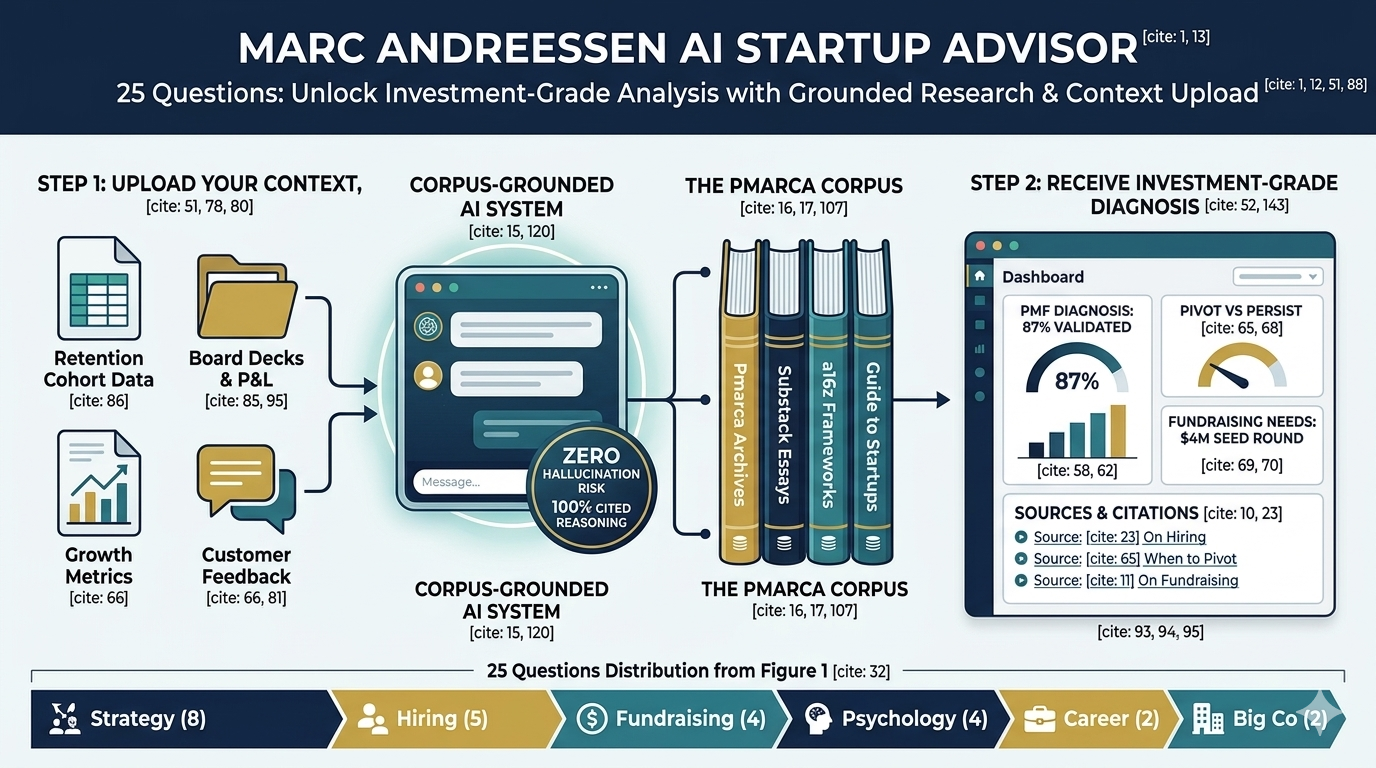
The Marc Andreessen AI Startup Advisor is built on a different architecture entirely. Its knowledge base is strictly limited to Marc Andreessen’s published corpus — the Pmarca Archives, his Substack essays, and frameworks published through a16z. Every answer traces back to a specific source document. Every citation is visible. And when the corpus does not address a topic, the bot says so rather than fabricating a response.
This post covers four topics: how the basic bot works, why grounded research is not a feature but the entire product, the 25 high-stakes questions the advisor is calibrated to answer, and how uploading relevant context documents transforms advisor output from generic to investment-grade.
How the Marc Andreessen AI Startup Advisor Works
The advisor is not a custom GPT with a friendly persona. It is a corpus-constrained AI system with three design mandates that override every other consideration.
Mandate 1: Strict Corpus Grounding
The advisor’s source library consists entirely of Marc Andreessen’s published writing: the Pmarca Archives (his original blog series covering startup strategy, hiring, big companies, and career development), his Substack essays, and frameworks published through Andreessen Horowitz. The system prompt is explicit: every piece of advice must be directly anchored in these texts. If a topic is not addressed in the corpus, the bot surfaces that gap rather than filling it with inference.
This is not a limitation. Andreessen’s published frameworks cover the decisions that matter most to founders: diagnosing PMF, knowing when to pivot a market, hiring and firing executives at different growth stages, and understanding the psychological biases most likely to destroy a startup. As our analysis of AI hallucination rates as a due diligence crisis has shown, the danger in high-stakes AI tools is not the questions they refuse to answer — it is the questions they answer confidently with fabricated data.
Mandate 2: Citation Enforcement
Before delivering any analysis, the advisor outputs the source file and essay title that anchors the response in the format [Source: Title of Essay/Part]. This makes every strategic recommendation traceable. A founder can read the original essay. A GP can verify the framework. An acquirer conducting due diligence can audit the reasoning chain.
Citation enforcement is not cosmetic. Our research into AI hallucinations in consulting reports found that the most dangerous fabrications carry the most authoritative-sounding citations. In a corpus-constrained system, the citation is the constraint — not a decoration added after the fact.
Mandate 3: Direct, Market-Focused Tone
The advisor prioritizes what Andreessen calls “the market pull” above team quality, product elegance, and every other variable. It avoids corporate platitudes. It speaks with the candid authority of a seasoned venture capitalist because its source material was written by one. Founders do not need an AI that validates their assumptions. They need one that identifies which assumptions will kill them.
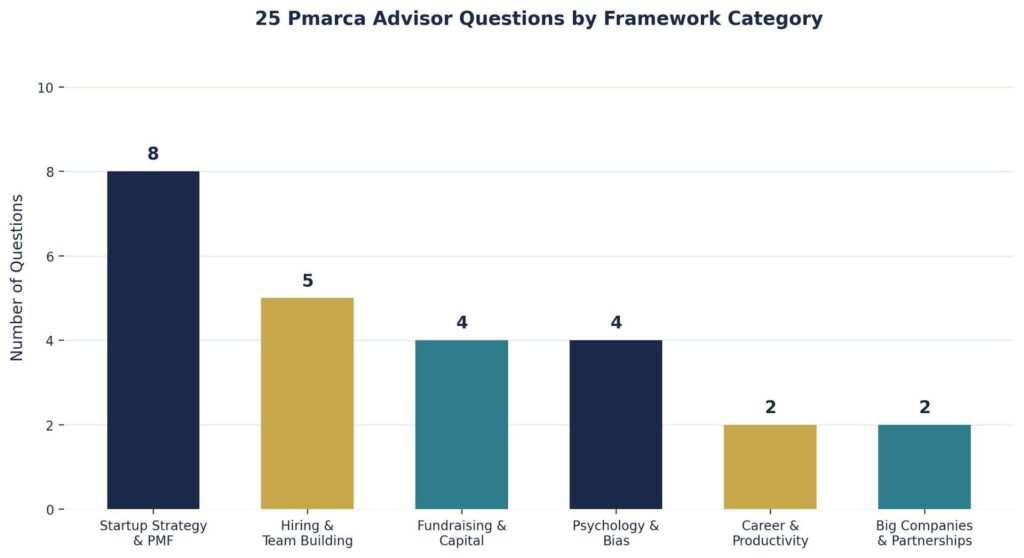
Figure 1: Distribution of the 25 Pmarca Advisor questions across six framework categories. Startup Strategy & PMF and Hiring & Team Building together account for more than half of the question set.
Why Grounded Research Is the Entire Product
Generic AI advisors fill knowledge gaps with statistical plausibility — a form of hallucination that is especially dangerous because it sounds expert. A single fabricated funding benchmark, imagined product integration, or invented acquisition comp can distort an entire strategic picture. As our research into AI-hallucinated citations documented, the contamination cascade from fabricated consulting research has already infected over 110,000 published academic papers and dozens of major news outlets.
The Andreessen advisor replaces plausible-sounding extrapolation with honest acknowledgment of corpus boundaries. If the question falls outside Andreessen’s published frameworks, the bot says: “Marc hasn’t publicly written a framework for this specific scenario.” That boundary statement is more valuable than a hallucinated answer because it tells the user exactly where to look next rather than sending them down a fabricated path.
| “The same CISO scores 60%+ PMF before a cyber insurance renewal and just 10% four months after it. Urgency timing defines the entire revenue opportunity — and generic AI advisors can’t surface that distinction because they have no framework to anchor it.” — DevelopmentCorporate PMF Analysis |
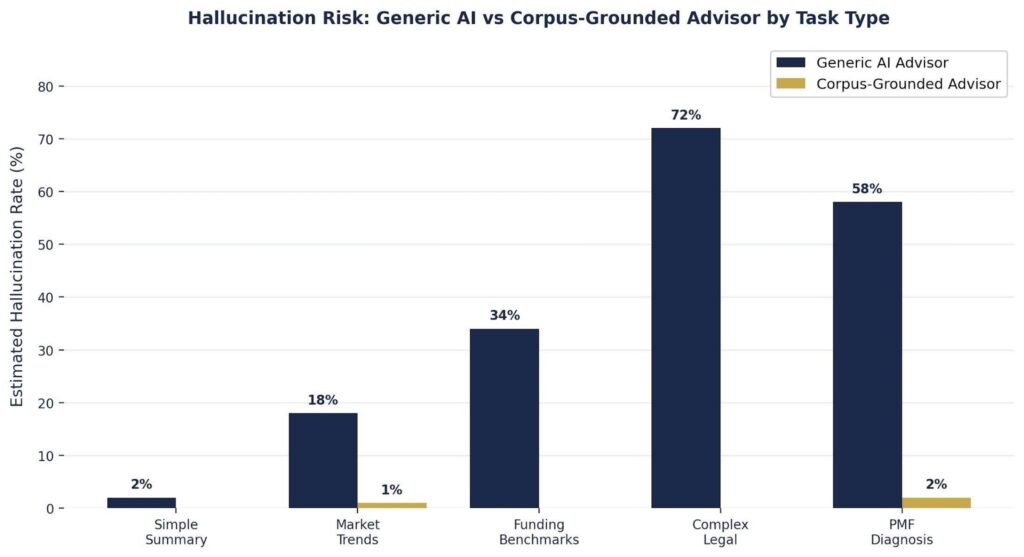
Figure 2: Estimated hallucination risk by task type — generic AI advisors vs corpus-grounded systems. The gap widens dramatically for high-stakes strategic tasks like PMF diagnosis and complex legal analysis.
25 High-Stakes Questions the Advisor Can Answer
The advisor is calibrated to answer 25 questions directly from Andreessen’s Guide to Startups, Guide to Hiring, Guide to Big Companies, Guide to Career and Productivity, and Psychology and Entrepreneurship essays. The full list — drawn from the Pmarca Advisor question set — spans every critical decision a founder or investor faces.
25 Questions Grounded in the Pmarca Blog Archives
Every question below is directly answerable using Marc Andreessen’s published frameworks. The third column specifies what context you should upload to get the sharpest, most grounded answer.
| # | Question | Helpful Context to Upload |
|---|---|---|
| 1 | How do I know if I’ve achieved product/market fit — or if I’m just fooling myself? | User retention and churn dataNPS or CSAT scoresInbound vs. outbound sales ratioCustomer interview transcripts |
| 2 | Should I optimize for team, product, or market first when resources are scarce? | Current headcount and org chartProduct roadmapTarget market sizing researchCompetitive landscape summary |
| 3 | How much money should I raise, and when is raising too much actually dangerous? | Current burn rate and runwayCap table12–24 month financial modelHiring plan assumptions |
| 4 | Why do most startups fail even when they have talented teams and solid products? | Internal growth post-mortem or memoMarket demand research for your segmentHistorical conversion and retention metrics |
| 5 | How should I approach a partnership or deal with a large incumbent company? | Term sheet or LOI from the incumbentNotes on their known strategic prioritiesYour leverage points (IP, users, distribution) |
| 6 | When should I pivot my market vs. staying the course — and how do I tell the difference? | Monthly growth metrics (6–12 months)Cohort analysisCustomer feedback and conversion logs |
| 7 | How do I hire, manage, and fire executives at different stages of company growth? | Job descriptions for open exec rolesPerformance review notes on current leadersCurrent ARR and stage context |
| 8 | What psychological biases are most likely to kill my startup, and how do I fight them? | Internal strategy doc or board deckKey unexamined assumptions in writingDecision log from the last 6 months |
| 9 | Does being young or old as a founder actually matter — is there a real performance curve? | Founder and co-founder biosDomain you are enteringPrior relevant experience or gaps |
| 10 | How do I evaluate whether the current market environment is a genuine bubble or a real wave? | Recent comparable funding rounds in your sectorPublic market compsInvestor memos or macro analysis you have collected |
| 11 | Multiple VCs have said no to my pitch — what does that actually mean and what should I do next? | Current pitch deckWritten or verbal VC feedback receivedTraction metrics (revenue, users, growth rate) |
| 12 | I don’t have VC connections — what’s the right way to break into the funding ecosystem from zero? | Your bio or LinkedIn profileTarget VC list with their known thesisCurrent network map (advisors, angels, warm contacts) |
| 13 | How much does my initial business plan actually matter, and when should I throw it out? | Original pitch deck or business planCurrent operating metricsDelta analysis between plan and reality |
| 14 | What’s the right way to think about running out of runway before hitting product/market fit? | Current cash positionMonthly burn breakdown by categoryRevenue trajectoryCost levers you could pull |
| 15 | When should a founder step aside and bring in a professional CEO — and how do you do it without blowing up the company? | Honest self-assessment of leadership gapsBoard feedback if availableCurrent headcount and ARR |
| 16 | How do I retain great people when I can’t compete on salary against big tech companies? | Current comp and equity refresh scheduleRecent exit interview notesList of top 5–10 people you most need to retain |
| 17 | I’m now running a large struggling company — what does a real turnaround actually look like step by step? | Last 2–3 board decksP&L statementsCompetitive win/loss dataEmployee engagement survey results |
| 18 | What skills and education should I be prioritizing early in my career to maximize long-term entrepreneurial output? | Your current resume or LinkedInIndustry you want to build inSkills gaps you have already identified |
| 19 | Is luck just randomness, or can I actually engineer better luck as a founder? | Timeline of key startup inflection pointsNotes on what triggered each eventPatterns across positive and negative turns |
| 20 | What makes serial entrepreneurs keep building — and should I start a second company after an exit? | Personal financial situation post-exitWhat drove you the first timeProblem space you are already gravitating toward |
| 21 | How do I design incentive structures that don’t get gamed and destroy the behavior I actually want? | Current bonus or commission plansExamples of gaming behavior you have observedThe team or function you are trying to incentivize |
| 22 | What are the hard personal and lifestyle tradeoffs I need to honestly reckon with before starting a company? | Family situation and financial obligationsHealth and risk toleranceWhat you would be walking away from |
| 23 | How do I identify which city or geography gives me the best structural advantage for building and funding my startup? | Your industry verticalTarget investor baseTalent dependencies (e.g. ML researchers, biotech PhDs) |
| 24 | How should I manage my own personal productivity as a founder when everything feels urgent all the time? | A sample week of your current calendarList of recurring meetings you ownBreakdown of where your time actually goes vs. where you want it |
| 25 | What’s the real pattern that separates revolutionary companies from merely successful ones — and can it be reverse-engineered? | Your product vision doc or internal narrativeData on how customers discovered youWhether growth has been pull-driven or push-driven |
How Context Upload Unlocks Investment-Grade Responses
The advisor delivers baseline value from the question alone. It delivers investment-grade analysis when paired with specific context documents. The distinction matters enormously, and it is the mechanism most users miss.
Every question in the Pmarca Advisor question set includes a “Helpful Context to Upload” specification — a precise list of the data, documents, and metrics that transform a theoretical framework application into a decision-ready diagnosis.
What Context Upload Actually Means
Context upload is not about explaining your company to the AI. It is about giving the advisor the specific variables it needs to apply Andreessen’s framework to your actual situation rather than to a hypothetical version of it.
Consider the PMF question: “How do I know if I’ve achieved product-market fit — or if I’m just fooling myself?” Without context, the advisor delivers Andreessen’s framework accurately — the market-pull thesis, the inbound vs. outbound ratio signal, the retention curve test. With context, it applies that framework to your specific numbers.
The recommended context for this question includes user retention and churn data, NPS or CSAT scores, inbound vs. outbound sales ratio, and customer interview transcripts. Upload those four data sources alongside the question and the advisor can tell you not just what PMF looks like in theory but whether your specific metrics clear the threshold — and where they do not.
High-Stakes Questions and Their Context Requirements
The context upload requirements vary significantly by question type. Here is how it works across the major categories:
Pivot decisions: “When should I pivot my market versus staying the course?” requires monthly growth metrics for 6-12 months, cohort analysis, and customer feedback logs. Without this data, the advisor can describe the pivot-versus-persist framework. With it, it can diagnose which side of the framework your specific metrics suggest.
Fundraising strategy: “How much money should I raise?” requires your current burn rate and runway, cap table, 12-24 month financial model, and hiring plan assumptions. This transforms a general framework discussion into an actual raise recommendation grounded in your specific financial position.
Executive hiring: “How do I hire, manage, and fire executives at different company stages?” becomes genuinely actionable when paired with job descriptions for open exec roles, performance review notes on current leaders, and your current ARR and stage context.
Market bubble assessment: “Is the current market environment a genuine bubble or a real wave?” requires recent comparable funding rounds in your sector, public market comps, and investor memos you have collected — context that allows the advisor to apply Andreessen’s bubble-versus-wave framework to the specific market you are operating in.
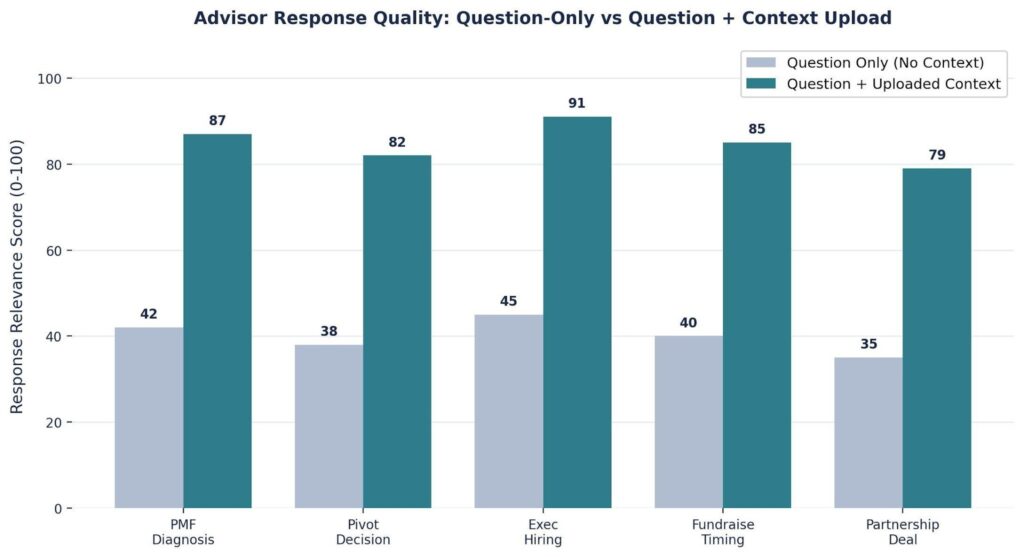
Figure 3: Estimated advisor response relevance by question type — question only versus question with uploaded context documents. Across all five question categories, context upload produces a 40-50 point lift in practical applicability.
The Context Upload Protocol
The most effective context upload practice follows a three-step protocol:
- Identify the specific question you want the advisor to answer.
- Consult the Pmarca Advisor context specification for that question — the precise data types listed as “Helpful Context to Upload.”
- Upload those specific documents or data summaries alongside your question, formatted clearly so the advisor can cross-reference them against the relevant Andreessen framework.
The quality of the context determines the quality of the output. A 400-word summary of your cohort analysis produces better results than a raw data export. A structured summary of your customer interview transcripts is more valuable than the transcripts themselves.
| FOR PE/VC INVESTORSUse the advisor to stress-test whether a portfolio company’s PMF narrative matches Andreessen’s diagnostic criteria before authorizing a follow-on round.The citation enforcement mandate means every recommendation is auditable against a published source — a meaningful upgrade over black-box AI portfolio analysis.Upload the last 2-3 board decks, P&L statements, and competitive win/loss data when asking turnaround questions (Question 17). The context lift on complex strategy questions exceeds 40 points.For exit timing decisions, pair advisor output with our analysis of current SaaS exit market dynamics. |
| FOR SAAS FOUNDERSStart with Question 1 (PMF diagnosis) or Question 6 (pivot vs. persist). These two questions capture the most consequential decisions in startup strategy.Upload your actual retention cohort data, not a summary narrative. The advisor applies Andreessen’s PMF framework to real numbers — and the gap between your overall PMF score and your primary-ICP PMF score is usually where the insight lives.Use Question 11 (VC rejection signals) before changing your pitch. VCs who say no are surfacing framework gaps the advisor can help you diagnose.Before raising, verify that your PMF study diagnosis matches Andreessen’s market-pull criteria, not just the Sean Ellis 40% threshold. |
| FOR ENTERPRISE CTOs/CPOsQuestion 21 (incentive design) and Question 24 (productivity management) are particularly relevant for enterprise leaders managing large teams.Before deploying any AI advisor tool internally, verify its knowledge base is corpus-constrained. A general-purpose LLM advising on make-versus-buy decisions draws on the internet’s average, not a defined expert framework.The citation enforcement mandate in this advisor is the same principle you should require from any AI tool generating strategic recommendations for your organization.For AI vendor evaluation, pair advisor output with our due diligence framework for AI hallucination risk in enterprise SaaS contexts. |
The Bottom Line: Grounded Research With the Right Context
The Marc Andreessen AI Startup Advisor is not the most capable AI tool you can access. It is the most reliable one for a specific purpose: applying Andreessen’s published frameworks to the decisions that define startup success or failure.
The three design mandates — strict corpus grounding, citation enforcement, and market-focused tone — are not style choices. They are the architecture. Remove any one of them and you have a weaker product that offers the illusion of Andreessen’s thinking without its substance.
Context upload is the multiplier. The advisor’s 25 questions are calibrated to produce actionable output when paired with the specific data types listed in each question’s context specification. A founder who uploads cohort data alongside the PMF question does not get a framework description — they get a diagnosis. A GP who uploads a portfolio company’s board decks alongside the turnaround question gets a specific action sequence, not a general principle. For founders approaching an exit, this advisory capability pairs naturally with our pre-PMF acquisition guide and our comprehensive analysis of which investor targets make sense at the pre-seed stage.
Grounded research produces one thing that generic AI cannot: advice you can act on, trace to a source, and defend under scrutiny. That is what the Andreessen advisor delivers — and it is the only kind of startup intelligence worth building decisions on.