
How to Incorporate AI Into Business Operations: Benefits, Challenges, and Best Practices
A guest post by Gloria Martinez (gloriamartinez@womenled.org)
Artificial Intelligence (AI) is no longer the domain of tech giants — it’s an operational catalyst available to any business ready to optimize processes, uncover insights, and enhance customer experience. Yet adoption requires a thoughtful approach that balances potential gains with strategic oversight.
Key Takeaways at a Glance
- Integrate AI where it enhances human judgment, not replaces it.
- Start small: pilot AI in one or two processes before scaling organization-wide.
- Use clear, measurable goals to track ROI on automation and analytics tools.
- Address ethical, data, and workforce challenges early.
- Align AI initiatives with core business strategy, not as a side experiment.
Understanding the Strategic Opportunity
Businesses across industries use AI to streamline repetitive tasks, personalize customer engagement, and make data-driven decisions at unprecedented speed. Whether through chatbots, predictive analytics, or process automation, AI can convert inefficiencies into competitive advantages.
But successful integration requires a dual mindset: innovation and governance. Without structure, AI projects risk becoming disjointed or ethically risky.
The Practical Benefits of Adopting AI
Here’s how AI can tangibly improve operations, profitability, and performance.
| Benefit Area | Description | Business Impact |
| Process Automation | Automates routine workflows in HR, finance, and logistics. | Frees employee time, reduces errors, lowers operational cost. |
| Predictive Analytics | Uses historical data to forecast demand, sales, or maintenance needs. | Enables smarter decisions and inventory optimization. |
| Customer Experience | Chatbots and recommendation engines deliver personalized interactions. | Boosts retention, upsell opportunities, and satisfaction. |
| Risk Management | AI detects anomalies, fraud, or compliance breaches in real time. | Reduces exposure and enhances trust. |
| Innovation Enablement | Data insights fuel product design and strategic planning. | Accelerates time-to-market and identifies new revenue streams. |
Where to Begin: A How-To Checklist
Implementing AI isn’t a single project — it’s a capability built over time. Use this checklist as a practical starting framework.
Before adoption:
- Identify business processes where AI can add measurable value.
- Audit data quality and availability — AI is only as strong as its inputs.
- Define key performance metrics (cost savings, efficiency gains, satisfaction).
- Align cross-functional teams (IT, operations, compliance, and leadership).
During deployment:
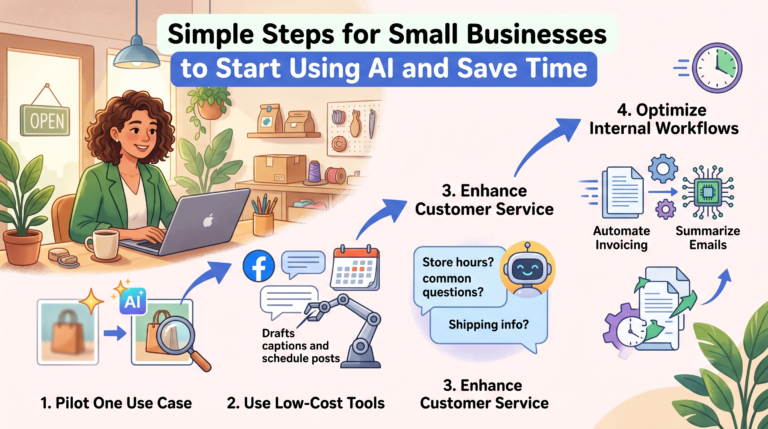
- Start with a pilot project using narrow, high-impact use cases.
- Choose transparent AI tools that provide interpretable results.
- Train employees to collaborate with — not against — AI systems.
- Establish oversight for ethical data use and model bias detection.
After rollout:
- Continuously monitor performance and recalibrate models.
- Scale successful pilots across departments.
- Maintain a human-in-the-loop for decisions with strategic or ethical weight.
Using AI for Faster, Smarter Content Creation
Visual storytelling is a critical growth driver in marketing. Businesses can now use AI-generated images to create compelling graphics in minutes — ideal for product listings, social media, and digital ads. Tools like a text-to-image generator provide huge time savings while maintaining brand consistency and creativity.
This is an excellent example of how AI can augment creative workflows and reduce production bottlenecks without replacing design teams.
Common Challenges and How to Navigate Them
AI adoption isn’t risk-free. The most common issues stem from unrealistic expectations or weak governance structures.
1. Data Readiness Gaps
Poor data quality or fragmented storage systems can derail AI initiatives before they start. Businesses should invest early in data cleaning, unification, and secure storage.
2. Workforce Resistance
Automation anxiety is real. Clear communication and retraining programs are essential to help teams see AI as a support system, not a replacement.
3. Ethical and Regulatory Concerns
Bias, privacy violations, and lack of transparency can damage trust. Always audit AI decisions and maintain compliance with emerging regulations like the EU AI Act or U.S. state privacy laws.
4. Overreliance on Vendors
Buying AI “out of the box” without customization leads to suboptimal results. Internal literacy — even at a basic level — ensures businesses remain in control of their models and outcomes.
5. ROI Measurement
Without clear metrics, AI can feel like a cost center. Tie each project to KPIs that directly link to revenue, savings, or customer growth.
Best Practices for Responsible Integration
Before scaling, companies should establish policies that ensure AI aligns with organizational ethics and business goals.
- Adopt a phased approach: Deploy, test, and refine in contained environments.
- Promote transparency: Make AI decision criteria understandable to both employees and customers.
- Design for augmentation: Focus on where AI complements human expertise — not where it substitutes it.
- Measure continuously: Treat AI as a living system that learns, evolves, and requires monitoring.
- Prioritize inclusion and accessibility: Ensure that AI outcomes serve diverse user groups fairly.
Frequently Asked Questions
Before closing, here are concise answers to common questions business owners ask about AI implementation.
Q: How much should a business budget for AI integration?
A: Start small — pilot projects can range from a few thousand dollars to mid five figures depending on complexity. Focus on measurable use cases first.
Q: Will AI eliminate jobs in my company?
A: AI tends to reshape roles rather than eliminate them. It handles repetitive tasks, allowing employees to focus on creativity, strategy, and relationship building.
Q: What data is needed to train an AI model effectively?
A: High-quality, representative, and ethically sourced data that reflects your customers and business context. Incomplete or biased data leads to poor model outcomes.
Q: How soon can we expect ROI?
A: Many companies report value within 6–12 months if AI is implemented in high-impact areas like operations or marketing automation.
Conclusion
Incorporating AI into business operations is no longer optional — it’s a necessity for resilience and innovation. The key is deliberate integration: start with clarity, ensure ethical guardrails, and keep humans in command of the strategy. Done right, AI doesn’t replace human intelligence — it amplifies it.
Businesses that treat AI as a strategic partner, not just a tool, will lead in the era of intelligent operations.