
Early-Stage Startup Funding in Q3 2025: What First-Time Founders Need to Know About Pre-Seed Trends
Early-stage startup funding just got more complicated—and more interesting. While headlines scream about declining deal counts and cooling markets, the data tells a more nuanced story that could dramatically affect your fundraising strategy.
If you’re a first-time founder preparing to raise your pre-seed round, understanding what actually happened in Q3 2025 matters far more than surface-level doom and gloom. The Carta State of Pre-Seed report reveals patterns that separate founders who secure capital from those who struggle—and the insights might surprise you.
Here’s what you need to know about the current early-stage startup funding landscape, translated from investor data into actionable intelligence for your raise.
What the Q3 2025 Data Really Means for Founders
Startups in the United States raised $965 million in pre-seed funding during Q3 2025 across 5,660 instruments, including SAFEs and convertible notes. That represents a modest decline from Q2’s higher watermark, and it’s tempting to interpret this as a bearish signal.
But zoom out, and the picture changes entirely.
Total pre-seed funding activity in 2025 is on track to outpace all of 2024. The market peaked at $1.2 billion in Q1 2025, and despite softer subsequent quarters, investment volume has been climbing steadily since late 2022. You’re not raising into a frozen market—you’re navigating a maturing one.
The critical question isn’t whether money is flowing. It’s where that money is flowing, and what that means for how you structure your raise.
The Capital Concentration Paradox: Small Rounds Are Proliferating, But Big Money Is Getting Bigger
Here’s the paradox keeping first-time founders up at night: Q3 2025 saw more rounds under $1 million than the same period in 2024, yet the total cash raised across rounds above $1 million was actually higher in 2025.
Translation? More founders are raising smaller checks, while fewer founders are capturing significantly larger ones.
This bifurcation reveals something crucial about investor psychology in the current market. Angels and pre-seed funds are still writing checks—they’re just being more selective about where they deploy serious capital versus where they make smaller bets. The median seed round size has been growing, but that growth is concentrated in fewer, higher-conviction deals.
What this means for your strategy:
If you’re raising under $1 million, you have more company than ever. Your pitch needs to answer not just “why this company” but “why this company deserves meaningful follow-on capital.” Investors placing small bets are increasingly thinking about who’ll write the next check, not just whether your product will work.
If you’re positioning for a larger round above $1 million, understand you’re competing for a shrinking pool of capital. The bar is higher, but the rewards for clearing it are substantial. Large rounds in this environment signal real investor conviction, which becomes currency in future raises.
The middle ground—rounds between $750K and $1.5M—may be the hardest to navigate right now. You’re too large to be a quick bet and potentially too small to justify the deep diligence larger rounds command.
Valuation Caps Are Rising—But Only If You Know Where to Look
Valuation caps on post-money SAFEs held remarkably steady across most round sizes during the past 12 months. For the typical sub-$1 million raise, don’t expect significant cap appreciation compared to early 2024.
But here’s where it gets interesting: valuation caps rose meaningfully for large round sizes of at least $2.5 million.
This isn’t random. Investors are paying premium valuations for companies that have achieved sufficient traction to command substantial pre-seed rounds. If you can credibly raise $2.5 million or more at the pre-seed stage, you’re in rare company—and you have leverage.
For convertible notes, valuation caps proved more volatile and trended upward across most round sizes. According to PitchBook’s venture capital analysis, this creates an interesting strategic consideration that most founders miss.
The tactical takeaway:
If your traction justifies a larger round and you’re deciding between a SAFE and convertible note, run the numbers on both. The convertible note market may offer better cap terms, though SAFEs remain the dominant instrument for good reason (we’ll get to that shortly).
If you’re raising a smaller round, resist the temptation to push hard on valuation. As we explored in our analysis of whether founders should chase sky-high seed valuations, steady caps mean investors have found an equilibrium they’re comfortable with. Fighting for an extra million on your cap when raising $500K can cost you momentum and burn social capital you’ll need later.
Geography Still Matters More Than You Think
Despite the promise of remote work and distributed teams, early-stage startup funding remains stubbornly concentrated. The Western census region continues to capture half of all pre-seed fundraising in the United States, with the Bay Area alone dominating the top five metros alongside New York, Boston, Los Angeles, and Washington D.C.
This isn’t just about where VCs have offices. It reflects genuine ecosystem effects that matter for first-time founders.
Capital concentration creates network density. In the Bay Area, your first angel investor likely knows your potential second, third, and fourth investors. Your technical co-founder can more easily recruit that senior engineer who takes a pay cut for equity. Your customers are often your neighbors, making user research and partnership conversations easier.
But concentration also creates opportunity costs. If you’re building outside these hubs, you face higher customer acquisition costs in some markets, longer fundraising cycles, and potentially less sophisticated early investors.
The geographic calculation:
For first-time founders, location is a three-dimensional decision matrix:
First, consider where your specific customers and talent pools concentrate. A fintech company might need New York proximity despite Silicon Valley’s capital advantages. A hardware startup might benefit from being near manufacturing centers, as European AI SaaS startups have discovered when navigating regional funding dynamics.
Second, evaluate your personal network density. If you have strong connections in Boston’s biotech scene but weak ties in the Bay Area, playing to your network strength often beats relocating to follow capital.
Third, think about virtual vs. physical presence. Some founders maintain legal entities in Delaware (standard practice according to Y Combinator’s incorporation guide), operations in lower-cost markets, and regular physical presence in capital-dense metros during fundraising. This hybrid approach is more accepted post-pandemic than ever before.
SAFEs vs. Convertible Notes: The Decision Just Got Easier
SAFEs continue their march toward total dominance as the preferred pre-priced instrument, even in sectors like biotech and pharma that historically favored convertible notes.
The shift reflects something important about market maturity. Y Combinator introduced the SAFE in 2013, and it took nearly a decade for the instrument to achieve near-universal acceptance. Now, with most investors comfortable with SAFE mechanics and legal teams having standardized templates, the transaction costs of choosing a SAFE over a convertible note have essentially disappeared.
Even more telling: the threshold for switching from pre-priced instruments to priced equity rounds has risen from around $3 million to $4 million. Companies are staying on SAFEs longer because they’re simply easier to execute than priced rounds, and investors are comfortable with this approach.
What this means for your documents:
Unless you have a specific reason to use a convertible note—perhaps an investor with strong preferences or unique deal terms that SAFEs don’t accommodate well—default to post-money SAFEs. You’ll close deals faster, spend less on legal fees, and avoid explaining why you chose the less common path to subsequent investors.
The post-money SAFE specifically matters because it provides clarity on dilution that pre-money SAFEs lack. If you’re still considering pre-money SAFEs in 2025, you’re swimming against a strong current. Post-money SAFEs now represent 87% of all SAFEs on Carta’s platform.
For founders who do choose convertible notes, remember that interest rates have declined to 7.5% following federal rate cuts tracked by the Federal Reserve. This is relevant for calculating conversion economics, particularly if you expect an extended runway before your priced round.
How to Position Your Raise in This Market
Now that you understand the landscape, here’s how to translate these insights into a competitive fundraising strategy:
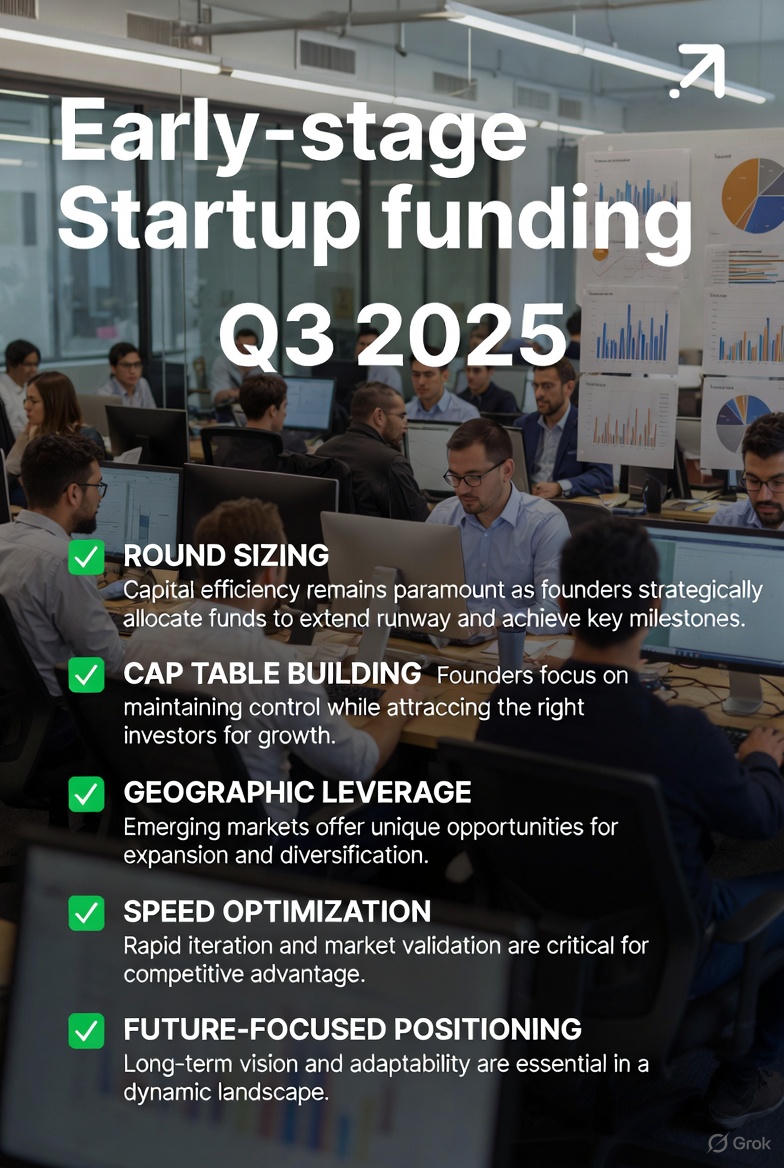
1. Size your round strategically, not aspirationally
The data shows clear clustering: many small rounds under $1 million, and fewer but larger rounds above that threshold. Avoid the awkward middle unless you have compelling reasons to be there.
If you can’t articulate why you need $1.5 million rather than $750K or $2.5 million, you’re probably targeting the wrong number. Investors notice vague justifications for round size. Understanding Q1 2025 private market dynamics reveals how crucial strategic round sizing has become.
2. Build your cap table with the next round in mind
Remember that capital concentration dynamic: small rounds are getting harder to follow with meaningful Series A interest. Every investor you add to your pre-seed round should be evaluated not just on the capital they provide, but on their ability to facilitate or participate in your next raise.
This is particularly crucial if you’re raising a smaller round. Your pre-seed investors are essentially placing a bet on whether someone else will place a bigger bet later. Choose investors who strengthen that narrative.
3. Use geography as a lever, not a limitation
If you’re based outside the major hubs, lean into it. Lower burn rates buy more runway, which gives you more shots on goal. But plan for regular travel to capital centers during active fundraising, and build relationships before you need them.
If you’re in a major hub, recognize that you’re competing with more sophisticated founders who have access to better advice and networks. Your execution bar is higher.
4. Optimize for speed and simplicity
The rise of SAFEs and the increasing threshold for priced rounds aren’t accidents. They reflect investor preference for moving quickly on deals they like. Make it easy to say yes.
This means: standardized documents, clear deal terms, minimal negotiation on non-essential points, and fast decision-making on your end. First-time founders often don’t realize that being difficult to work with at the pre-seed stage creates reputation risk in small investor communities.
5. Understand you’re selling future potential, not current metrics
Pre-seed investors know your metrics are early. What they’re evaluating is rate of learning, quality of execution, and credibility of your vision. The companies raising those larger rounds with better valuation caps aren’t just showing better numbers—they’re demonstrating clearer paths to eventual Series A metrics.
Your pitch needs to connect the dots between where you are now and where you’ll be in 18-24 months when you raise your next round. The more credible that path, the more likely you capture investor attention. Resources like Crunchbase’s startup funding insights can help you understand what investors look for at each stage.
The Bottom Line for First-Time Founders
Early-stage startup funding in Q3 2025 isn’t worse than previous quarters—it’s more selective. Capital is flowing, but it’s flowing to founders who understand current market dynamics and position their raises accordingly.
The key insights to remember:
More small rounds are closing, but serious capital remains concentrated in fewer, larger deals. Your round size is a signal about your ambition and traction.
Valuation caps are stable for most founders, rising only for companies raising substantial amounts. Don’t fight battles over caps unless you have leverage.
Geography matters, but it’s not destiny. Optimize for where your customers, talent, and network concentrate, then bridge gaps through strategic travel and virtual connection.
SAFEs have won the instrument debate. Use them unless you have compelling reasons not to, as outlined in Y Combinator’s extensive SAFE documentation.
The companies that succeed in this environment will be those that move quickly, execute consistently, and build relationships before they need them. The data shows money is available—it’s just choosier about where it lands.
Understanding these patterns doesn’t guarantee you’ll raise capital. But it does ensure you won’t waste time fighting battles that don’t matter while missing opportunities that do.
[IMAGE: Infographic summarizing the five key strategic takeaways for founders: round sizing, cap table building, geographic leverage, speed optimization, and future-focused positioning. Alt text: “Five strategic insights for raising early-stage startup funding in 2025 market conditions”]
Ready to Dive Deeper?
This analysis scratches the surface of Carta’s comprehensive State of Pre-Seed Q3 2025 report. The full report includes detailed breakdowns by industry sector, deeper geographic analysis, dilution trends, discount percentages, and dozens of additional charts that can inform your fundraising strategy.
For additional context on how these Q3 trends fit into the broader 2025 venture landscape, read our analysis of Q1 2025 private markets and what pre-seed SaaS founders must know.Download the complete State of Pre-Seed Q3 2025 report from Carta to access the full dataset and make data-informed decisions about your raise.