The Complete Guide to Building Synthetic User Panels for B2B SaaS
If you are a founder or Product Manager in early-stage B2B SaaS, you are likely stuck in the “Feedback Vacuum.”
You have a hypothesis. You have a pitch deck. But you don’t have users. To get users, you need feedback to iterate your product. But to get feedback, you need users.
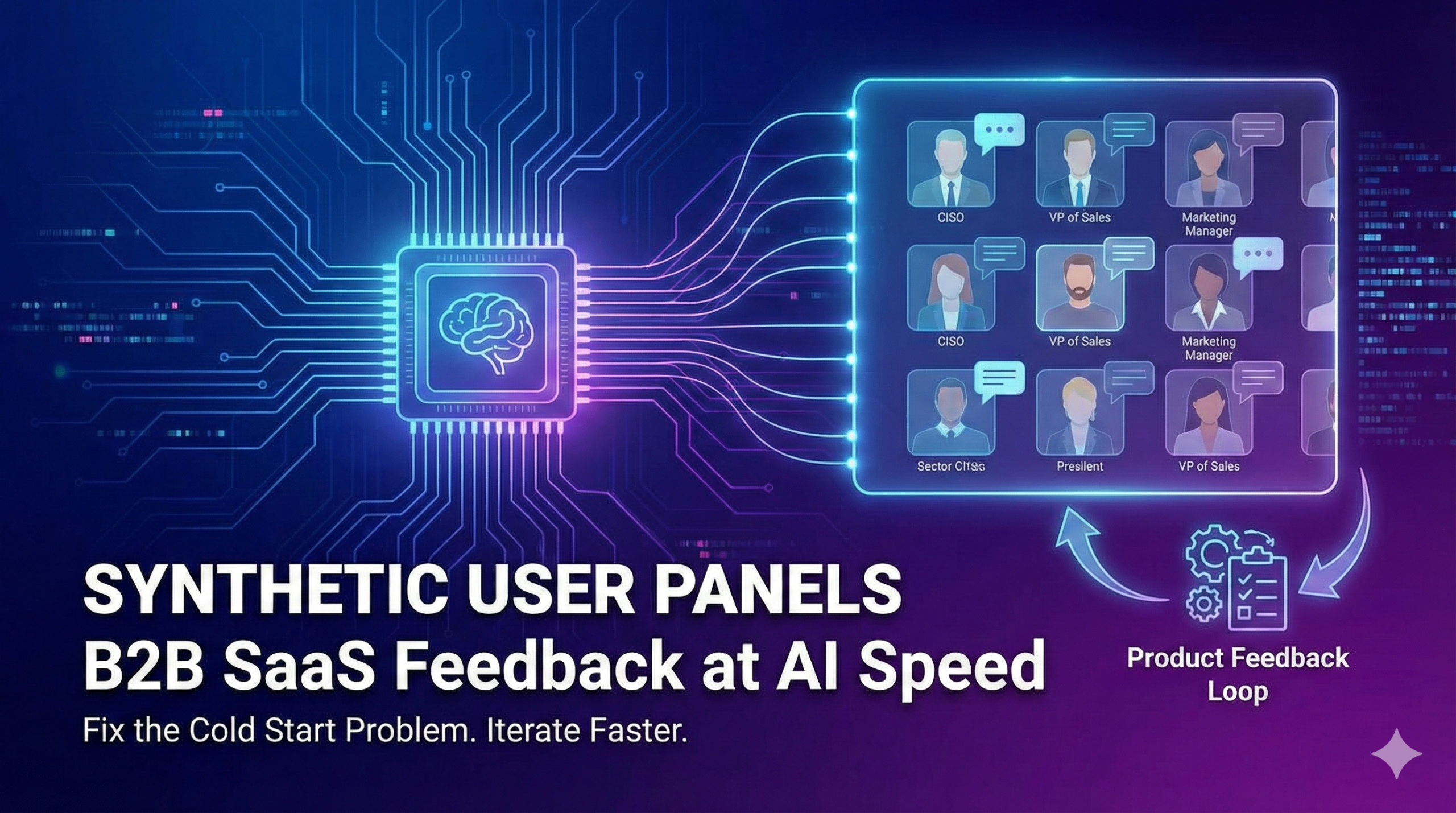
In the consumer world, you can solve this by surveying strangers in a coffee shop. In the enterprise world, you cannot. You cannot walk into a coffee shop and find a CISO (Chief Information Security Officer) of a Series B Fintech company who has 30 minutes to spare.
This is the Cold Start Problem. And for years, the only solution was to beg for warm intros or pay $1,000/hour for expert networks like GLG.
But the game has changed.
With the rise of Large Language Models (LLMs) like GPT-4 and Claude 3.5, we can now create Synthetic User Panels. We can instantiate high-fidelity digital twins of your buyers, ground them in real data, and simulate months of customer discovery in a single afternoon.
This is not science fiction. It is the new baseline for AI-Accelerated Strategy.
This guide is a comprehensive overview of how to build, run, and validate a synthetic research panel for your startup.
Table of Contents
- ** The Strategy:** Why Synthetic Data Fixes the “Cold Start” Problem
- The Build: How to Engineer High-Fidelity Personas
- The Execution: 3 Ways to Grill Your Panel for Insights
- The Validation: How to Avoid Hallucinations (The Sandwich Method)
- The Future: Ethics, Bias, and the New Role of the PM
Part 1: Why Synthetic Data Fixes the “Cold Start” Problem
The traditional model of qualitative research is broken for startups. It is too slow, too expensive, and paradoxically, too polite.
The “Politeness Bias”
As Rob Fitzpatrick details in The Mom Test, humans are socially conditioned to be nice. When you show a prospect your MVP, they will lie to spare your feelings. They say, “This looks great!” when they mean, “I would never buy this.”
Synthetic users do not care about your feelings. If you prompt them correctly, an AI persona will brutally evaluate your product based purely on logic, budget constraints, and feature fit. It offers “Brutal Honesty” at scale.
Directional vs. Statistical
The Golden Rule of synthetic research is simple: This is Directional, not Statistical. You do not use AI to predict your exact conversion rate (e.g., “3.4%”). You use it to find the “Neighborhood of Truth.” It tells you where your messaging is confusing and why your pricing model might fail, allowing you to de-risk your strategy before you write code.
- Read the full Deep Dive: Why Your Next 50 Customer Interviews Should Be Synthetic
Part 2: Engineering High-Fidelity Personas
Most people fail at synthetic research because they treat the AI like a chatbot. They type: “Act like a Marketing Manager and review my site.”
This yields generic, “Internet Consensus” garbage. To get value, you must move from Prompting to Engineering.
The 4-Part System Prompt
To build a persona that mirrors your Ideal Customer Profile (ICP), you need a structured “Character Sheet”:
- Demographics: “You are a VP of Sales at a Series A company.”
- Psychographics: “You are under pressure to hit quota. You are skeptical of tools that require long onboarding.”
- Context Grounding: “You use Salesforce and Slack. You hate manual data entry.” (Tip: Feed the model real G2 Reviews of your competitors to ground the personality in reality).
- The Mission: “Your goal is to find reasons NOT to buy this product.”
The “Anti-Persona”
Don’t just build the customer you want. Build the customer you fear. Create “Budget-Hawk Bob,” a synthetic CFO programmed to reject every purchase request that doesn’t show immediate ROI. If you can win an argument with him, you are ready for the real world.
- Read the full Deep Dive: Beyond “Act Like a CEO”—Engineering High-Fidelity Synthetic Personas
Part 3: Running the Simulation
Once you have your panel of “Synthetic CISOs” or “Virtual HR Directors,” what do you do with them? You don’t just chat. You Simulate.
Here are the top 3 workflows we use at Development Corporate:
1. The Landing Page Roast
Feed your landing page copy to the panel. Ask them: “Identify the 3 most confusing sentences on this page. If you saw this ad, would you click it? Rate your interest 1-10.” This helps you identify “Cognitive Friction” instantly.
2. The RICE Score Simulator
Struggling to prioritize your roadmap? Ask your synthetic panel to rank your proposed features based on their specific KPIs (e.g., Security, Speed, ROI). You will often find that what the Users want (Dark Mode) is different from what the Buyers want (Audit Logs).
3. The Sales Dojo (Objection Handling)
Paste your sales script into the chat. Instruct the AI to act as a Gatekeeper who refuses to take a meeting. Practice your objection handling against the AI until you can consistently convince it to say “Yes.”
- Read the full Deep Dive: Running the Simulation—3 Ways to Grill Your Synthetic Panel
Part 4: Trusting the Data (The Validation Sandwich)
The most common question is: “Is this real, or is the AI hallucinating?”
In this context, a hallucination isn’t a factual error; it’s a Behavioral Drift. It’s when the AI agrees to buy your product just to be nice (Sycophancy).
To solve this, we use the “Validation Sandwich” Protocol:
- Real Human Insight (Small Batch): Talk to 3 real humans. Learn their vocabulary and top-of-mind pains.
- Synthetic Scale (Large Batch): Use those insights to program your AI panel. Run 100 simulations to test pricing, features, and messaging. Generate a hypothesis (e.g., “They prefer usage-based pricing”).
- Real Human Validation (Targeted Batch): Go back to 3 new real humans. Ask them specifically about the hypothesis. “We are thinking about usage-based pricing. Does that work for you?”
This method ensures you never rely solely on AI, but you never waste human time on basic discovery.
- Read the full Deep Dive: Hallucination vs. Simulation—How to Trust Your Synthetic Data
Part 5: Ethics, Bias, and the Future
Synthetic research is a superpower, but it has guardrails.
The “WEIRD” Bias
LLMs are trained on the internet, which is Western, Educated, Industrialized, Rich, and Democratic. If you are building tools for global markets (e.g., rural agriculture in Brazil), the default AI models may carry Western business biases that don’t apply. You must prompt-engineer around this.
The Privacy Rule
Never paste PII (Personally Identifiable Information) into a public LLM. Do not upload customer transcripts containing names or emails. Always anonymize your data or use Enterprise-grade instances of models.
The New Product Manager
The role of the PM is shifting from “Gatherer” (taking notes, booking calls) to “Orchestrator.” The PM of the future is a scientist who designs simulations, interprets synthetic data, and validates it with human empathy.
- Read the full Deep Dive: The Synthetic Trap—Ethics, Bias, and the Future of Automated Discovery
Conclusion
The “Cold Start” problem is optional.
By building a Synthetic User Panel, you are creating a sandbox for strategy. You can crash-test your ideas, get roasted by virtual executives, and refine your pitch—all before you wake up and check your email.
It is cheap. It is fast. And in a world where speed is the only advantage a startup has, it is a superpower.
Ready to Build Your Panel?
If you are a Series A founder or Product Leader, you don’t have time to copy-paste prompts all day. You need a persistent, calibrated synthetic market.
At Development Corporate, we build bespoke “Synthetic Market Environments” for our clients. We ingest your competitor data, build your personas, and run the simulations for you.
Contact us today to schedule a demo and start getting feedback from your future customers tonight.