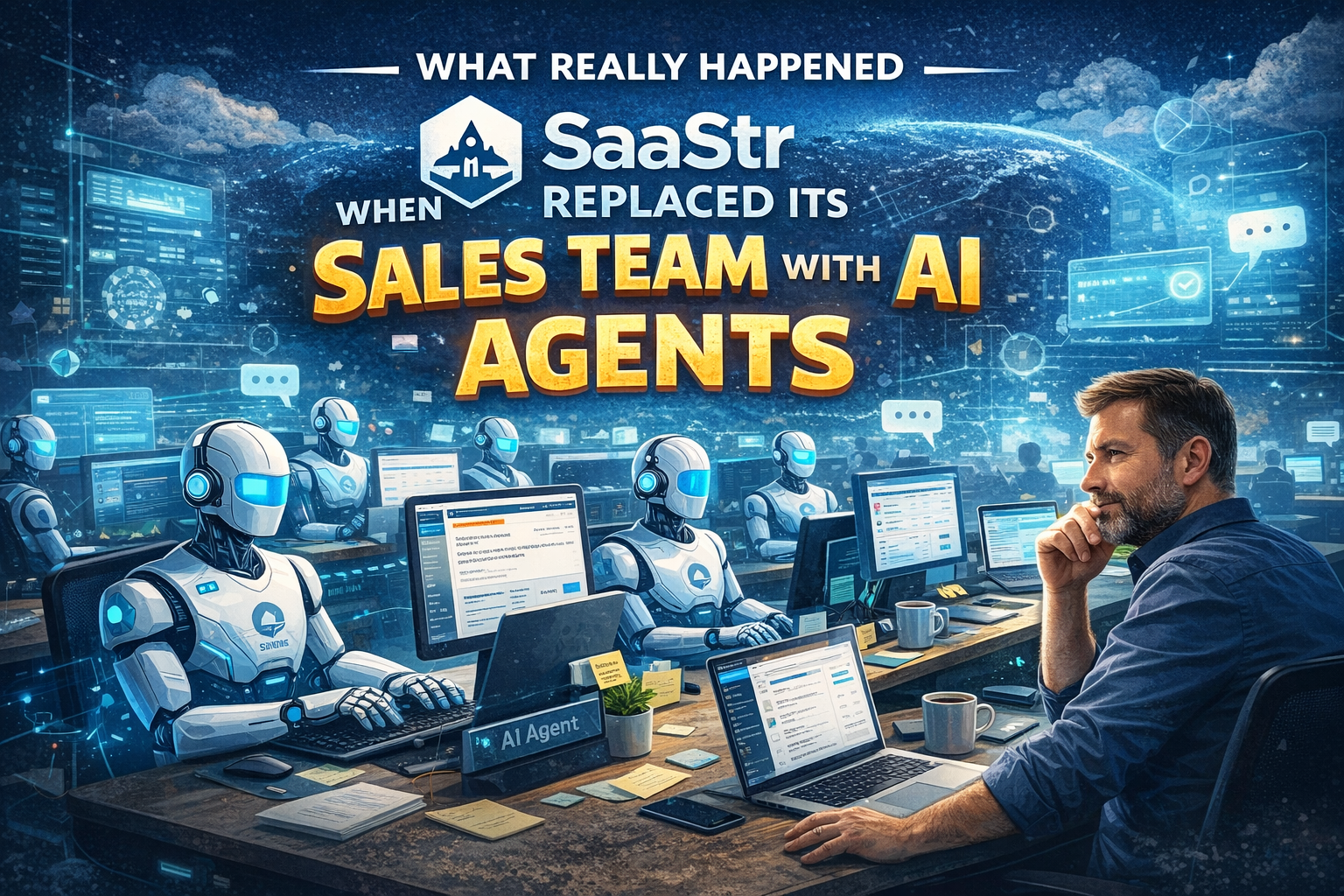
What Really Happened When SaaStr Replaced Its Sales Team with AI Agents
In early 2026, Jason Lemkin, founder of SaaStr—one of the world’s largest SaaS communities—shared a groundbreaking and controversial experiment that has serious implications for sales, go-to-market strategy, and the limits of autonomous AI systems. Rather than rebuilding a traditional human sales team after sudden departures, Lemkin chose to replace most of his sales organization with AI agents.+1
What followed has become a real-world case study on the promise—and pitfalls—of agentic AI in business.
The Experiment: From 10 Humans to 20+ Agents
In a January 1, 2026, episode of Lenny’s Podcast, Lemkin described how SaaStr shifted from a 10-person sales team to a setup where ~20 AI agents handle outbound, inbound, and qualification work with about 1.2 human supervisors—and roughly equivalent results.+1
“We have 10 desks that used to be go-to-market people. They’re all just labeled with our agents… Agents work all night, they work weekends, and they work on Christmas.” — Jason Lemkin, Lenny’s Podcast (approx. 00:04:00) +1
This AI agent stack includes specialized bots for:
- Outbound outreach
- Inbound qualification
- Follow-up sequencing
- Salesforce integration
While AI agents can mirror the behavior of SaaStr’s best human reps, Lemkin has made clear repeatedly: this is not a “set-and-forget” solution.
Not Just Productivity — But Coordination Challenges
Although Lemkin hasn’t published a verbatim blog post about a specific “offsite argument” between agents, his interviews strongly imply the kinds of coordination and logic-loop issues that can emerge when autonomous agents communicate without strong guardrails.
Evidence of Logic-Loop Concepts
In discussions on agent training and oversight, Lemkin has emphasized that:
- Agents must be trained daily for 30+ days before reaching high effectiveness.
- Agents sometimes generate outputs (e.g., messaging or inferred data) that require human correction and verification.
- A human “orchestrator” (in SaaStr’s case, a Chief AI Officer) spends 1–2 hours daily reviewing and refining agent behavior to prevent drift.
The underlying phenomenon is described repeatedly: multiple agents working on intersecting tasks can introduce inaccurate context or hallucinated facts, which then propagate through automated workflows if not human-reviewed. For more on the risks of unchecked automation, see The AI Sales Productivity Paradox.
“The classic sales motions still work, but our playbooks are broken in the AI era… training, ingestion, and orchestration matter more than people realize.” — Jason Lemkin, Lenny’s Podcast +1
What Lemkin Says About Oversight and Guardrails
In his 2026 commentary, Lemkin makes several points regarding the need for human supervision and a central “truth layer”:
Human Oversight Still Required
“If you pick a tool and don’t train it, you’ll fail. Agents must be trained and QA’d every day for weeks.” — Lenny’s Podcast (~ 00:23:50) +1
Salesforce as a Source of Truth
In other formats, such as The Revenue Leadership Podcast with Kyle Norton, Lemkin stressed that CRMs like Salesforce must be the central hub of truth so agents don’t invent data:+1
“Salesforce is the hub every agent needs — otherwise the agents just invent things because they don’t have a truth layer to check against.” — Topline Podcast (Dec 17, 2025) +1
This highlights an operational reality: agents do not have their own “ground truth”—they rely on data sources and human direction. Without it, agents can perpetuate hallucinatory or logically inconsistent outputs. This aligns with the necessity for executives to understand the underlying data before deploying automated systems, as discussed in AI-Powered Customer Research: Insights for B2B CEOs.+1
Lessons from SaaStr’s AI Agent Experiment
| Insight | Lemkin’s Take |
| AI can execute routine sales tasks | Agents trained well can match mid-level human GTM performance with scale. |
| Human supervision remains critical | Agents need review, QA, and correction daily. |
| Sales jobs are being re-defined | Junior SDRs focused on messaging are likely to decline. |
| Coordination requires guardrails | CRMs and truth layers are essential to avoid drift. |
Conclusion
Jason Lemkin’s experiment at SaaStr shows the enormous potential of autonomous agents to sustain core GTM functions with fewer humans, but it also exposes the real operational risks when agents are left unchecked.
While there is no public transcript titled “The Offsite Argument,” Lemkin’s documented positions illustrate that AI agents can generate their own internal assumptions; when multiple agents act on those assumptions without proper oversight, coordination problems emerge. This reality is exactly why he calls for strong human supervision and truth layers.