
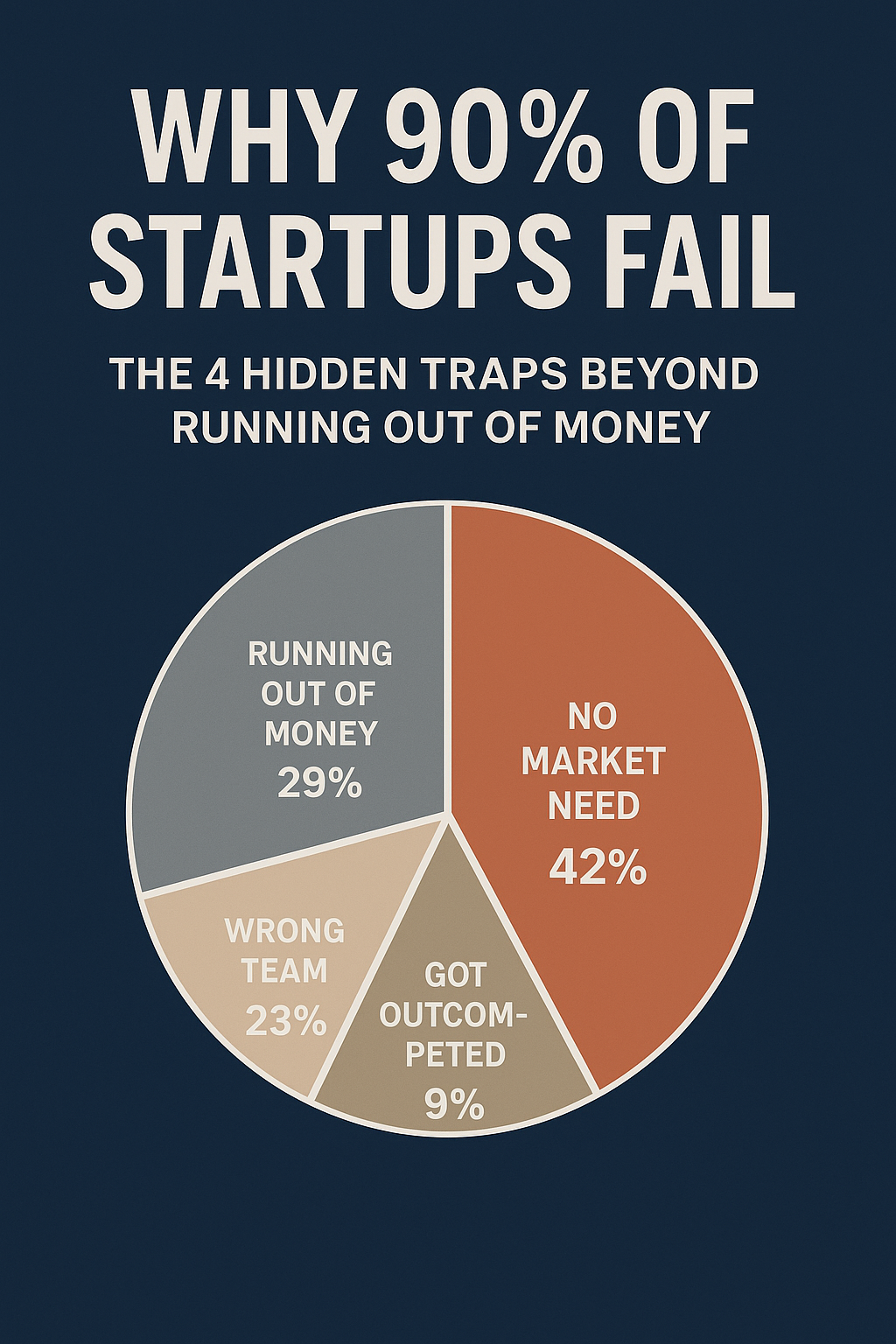
Why 90% of Startups Fail: The 4 Hidden Traps Beyond Running Out of Money
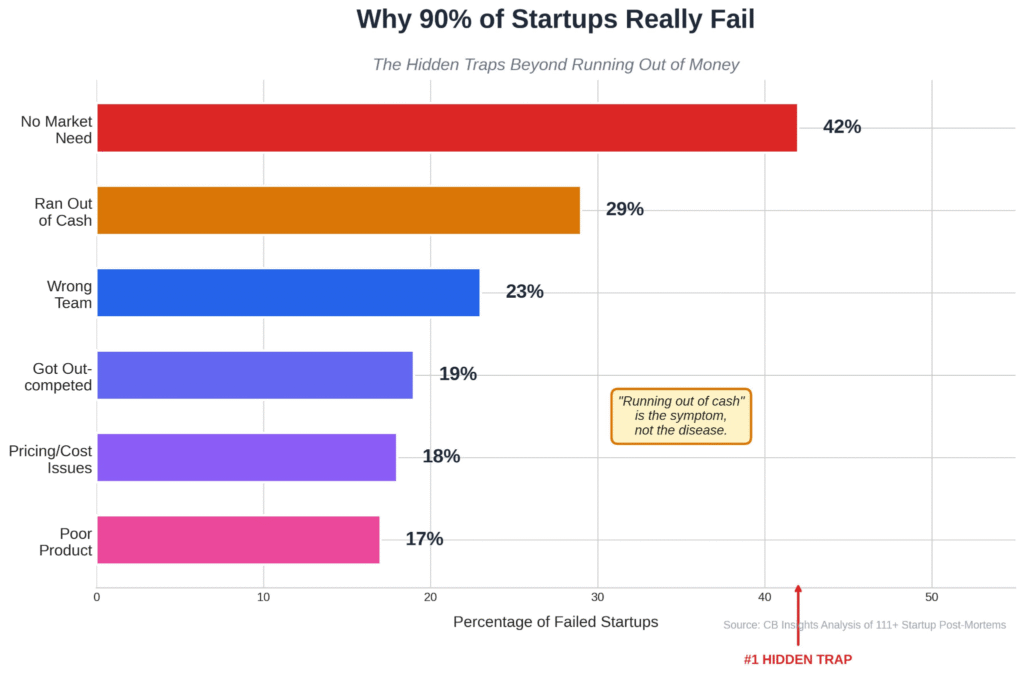
When a startup dies, the autopsy report almost always lists the same cause of death: it ran out of money. The data supports this, with analyses from CB Insights showing that 29% of failed startups attribute their collapse to running out of funding or cash flow. It’s the easy, obvious answer.
But it’s rarely the whole story. Financial collapse is often just a symptom of deeper, strategic mistakes. It’s the final fever spike of a disease that took root months or even years earlier. To truly understand why 90% of startups fail, we have to look past the empty bank account and identify the root causes.
This article distills insights from expert analyses, founder post-mortems, and venture capital reports to reveal four of the most impactful and counter-intuitive reasons startups really fail—the hidden traps that drain the cash and stop promising ventures in their tracks.
1. The #1 Reason for Failure Isn’t Cash, It’s Customer Apathy
The single biggest reason startups fail is not financial but strategic. According to a widely cited analysis of founder post-mortems by CB Insights, a staggering 42% of startups fail due to “No Market Need.” They build a solution for a problem that is either trivial or non-existent for a large enough group of customers.
In these cases, running out of cash is the proximate cause—the final event—but a lack of Product-Market Fit (PMF) is the root cause, the underlying disease. This creates a fatal feedback loop: a product nobody truly needs leads to an inefficient burn rate and poor traction. This lack of momentum makes it impossible to raise more funds, which ultimately causes the company to run out of money. If you’re a very early-stage founder, understanding how to measure product-market fit is essential to avoiding this trap.
As venture firm NFX notes, blaming failure on an empty bank account is like saying a person died from loss of blood without asking about the wound:
“There’s always an easy answer – the cause of death is loss of blood. The company ran out of money trying to find a good opportunity and couldn’t raise and earn more. But why? Well, a ‘gunshot wound.’ Okay, why? What’s going on?”
But what happens when founders believe they’ve found a market need, only to be dangerously mistaken? This leads to the second hidden trap: the false positive.
2. The “False Positive” Trap: When Early Success Is a Warning Sign
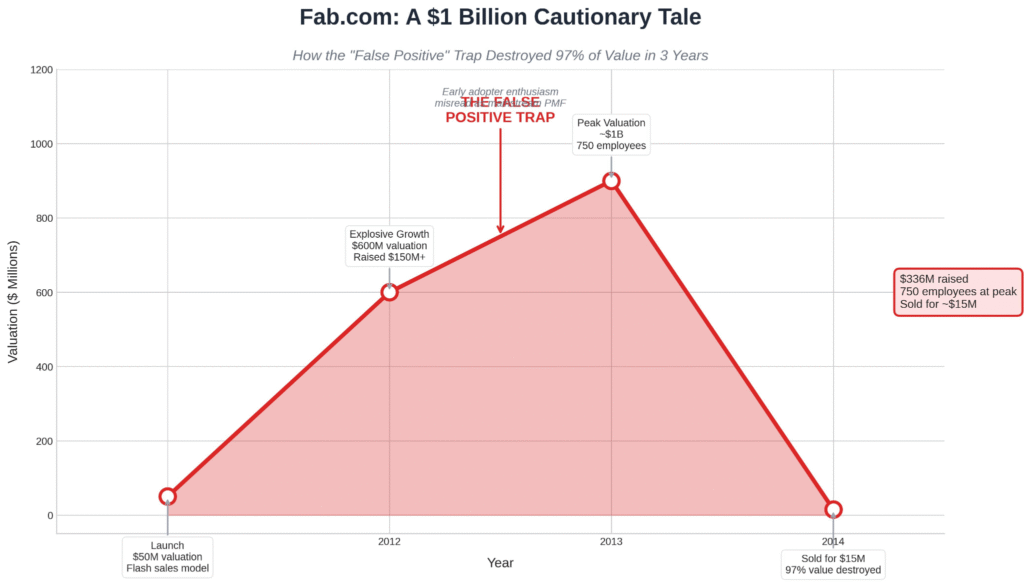
One of the most dangerous and counter-intuitive startup failure patterns is the “False Positive.” According to Harvard Business School Professor Tom Eisenmann’s research, this trap is sprung when a startup achieves enthusiastic adoption from a small, niche group of “early adopters,” which convinces the founders they have achieved Product-Market Fit.
Venture firm NFX points to the classic case of Fab.com, an e-commerce site founded by Jason Goldberg that saw explosive initial growth from a niche group of design enthusiasts. The company raised over $336 million and reached a valuation of $1 billion, only to realize the mainstream market did not share the same tastes—a fatal miscalculation that led to its sale for less than $30 million.
The danger is that this misplaced confidence leads to premature scaling. Believing they have a validated hit, founders recklessly increase their burn rate on marketing and hiring to chase a mainstream market that does not share the same intense needs as the initial niche users. The product that was a “must-have” for a few becomes a “nice-to-have” for the many.
This is a particularly lethal trap because it feels like success. It validates the founders’ vision and generates positive initial metrics, making the underlying problem difficult to recognize until cash reserves are critically low and the response from the wider market is anemic. Understanding current SaaS fundraising trends can help founders calibrate their growth expectations against market realities.
This lethal trap highlights a critical need: a reliable way to measure true Product-Market Fit that cuts through the noise of early enthusiasm. Fortunately, such a tool exists.
3. The 40% Rule: A Simple Litmus Test for Product-Market Fit
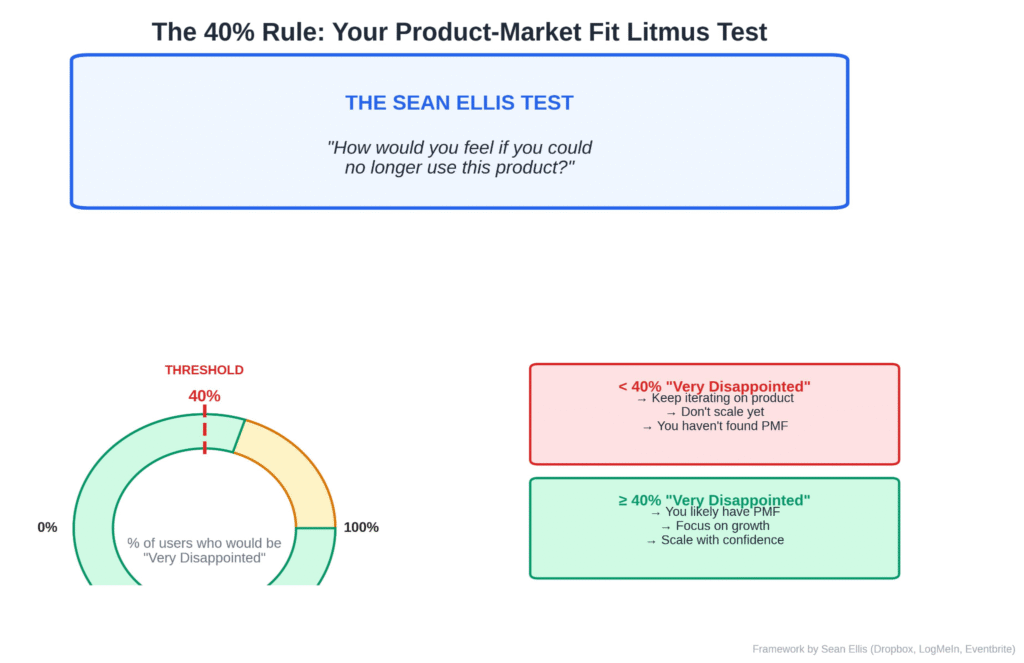
To avoid the “False Positive” trap, founders need a reliable way to measure true Product-Market Fit that cuts through vanity metrics like signups and daily active users. The Sean Ellis 40% Test is a powerful, predictive tool designed to do just that.
Sean Ellis, the growth expert who coined the term “growth hacking” and led early growth at Dropbox, LogMeIn, and Eventbrite, developed this test based on a simple core question posed to active users:
“How would you feel if you could no longer use this product?”
The possible answers are “Very disappointed,” “Somewhat disappointed,” or “Not disappointed.”
The “40% Rule” is simple: If 40% or more of your users answer “very disappointed,” you likely have strong PMF and can begin to scale confidently. If your score is below 40%, you should continue to iterate on your product and value proposition before committing to aggressive growth. According to First Round Capital’s analysis of Superhuman’s PMF journey, companies that struggled to find growth almost always had less than 40% of users respond “very disappointed,” whereas companies with strong traction almost always exceeded that threshold.
This works because it separates mild interest from genuine need. Users who would be “somewhat disappointed” will likely find an alternative. But the users who would be “very disappointed” truly need your product, are unlikely to churn, and are your most powerful advocates. This single question measures the “must-have” factor that is the true heart of Product-Market Fit. For a deeper dive into PMF measurement methodologies, explore why PMF studies cost more than $10,000 and what rigorous validation actually involves.
But even with a validated product and a hungry market, a startup’s biggest asset can quickly become its most dangerous liability: the founding team itself.
4. Co-Founder Conflict: The Ticking Time Bomb
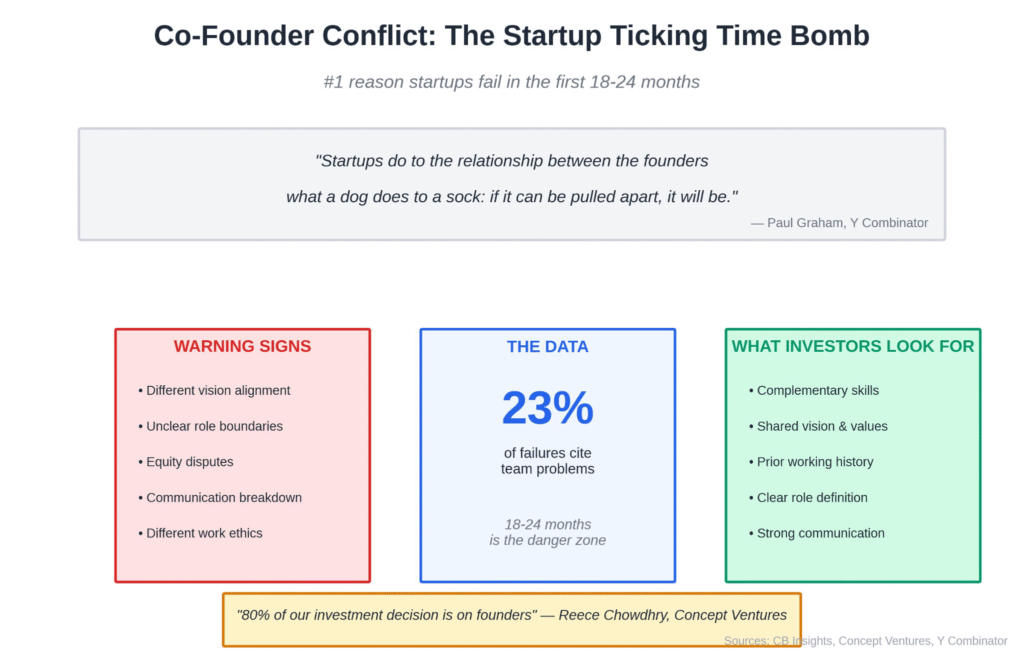
While a lack of Product-Market Fit is the leading cause of startup death overall, another killer often strikes much earlier. According to Reece Chowdhry, founding partner of Concept Ventures (Europe’s largest dedicated pre-seed fund), the number one reason startups fail within the first two years is that the founders fall out with each other.
In a recent interview with CNBC, Chowdhry explained: “The number one reason companies typically fail in the first 18 to 24 months is that founders fall out with each other or don’t get along, don’t have the same vision alignment, purpose, and so that is something that we think is really important.”
The intense pressure of a startup’s early stages—long hours, financial uncertainty, and constant decision-making—acts as a powerful stress test on the founding team’s relationship, vision, and alignment. Disagreements over strategy, roles, and equity can quickly escalate into company-killing conflicts.
As startup guru Paul Graham of Y Combinator memorably analogized in his essay “What We Look for in Founders”, the founder relationship must be incredibly resilient:
“Startups do to the relationship between the founders what a dog does to a sock: if it can be pulled apart, it will be.”
This is why investors scrutinize the co-founder dynamic as much as the business idea itself. A team with complementary skills, a deeply shared vision, and mutual respect can navigate immense challenges. A team without that foundation is a ticking time bomb. For founders preparing to raise capital, understanding what makes startups transaction-ready includes having a cohesive founding team story.
Conclusion: Avoiding the Autopsy
The 90% startup failure rate is daunting, but the patterns of failure are knowable and largely avoidable. The post-mortems of failed companies reveal that survival depends less on the brilliance of an initial idea and more on the disciplined execution of fundamentals.
It requires an obsessive focus on solving a real problem for a real market, the wisdom to differentiate true product-market fit from the misleading enthusiasm of a niche audience, and the maturity to build a resilient founding team that can withstand the immense pressures of the journey. The co-founder relationship is as critical as the product itself, and measuring what matters is the only way to navigate the fog of early growth.
Instead of asking, “Do I have a million-dollar idea?”, perhaps the better question is, “Am I relentlessly focused on solving a million-dollar problem for my customers?” The answer often makes all the difference. If you’re in the early stages of building your company, studying successful startup pitch deck examples and understanding current seed funding trends can help you prepare for the fundraising journey ahead.
Ready to Validate Your Startup’s Product-Market Fit?
Development Corporate helps early-stage SaaS founders conduct rigorous PMF validation, competitive intelligence, and go-to-market strategy development. Contact us to learn how we can help you avoid the hidden traps that sink 90% of startups.