Synthetic Users in 2026: Why 97% of Researchers Use AI but Only 8% Trust AI-Generated Participants
Synthetic users were supposed to be the next platform shift in customer research. Vendors promise AI-generated participants that compress weeks of recruiting into hours, slash panel costs to zero, and conjure feedback from hard-to-reach personas like enterprise CTOs on demand. Bain has profiled synthetic customers earning their stripes in consumer research. Qualtrics reports that 69% of market research professionals have already touched synthetic responses, with 87% satisfaction. The narrative is set: resistance is friction, and friction always loses.
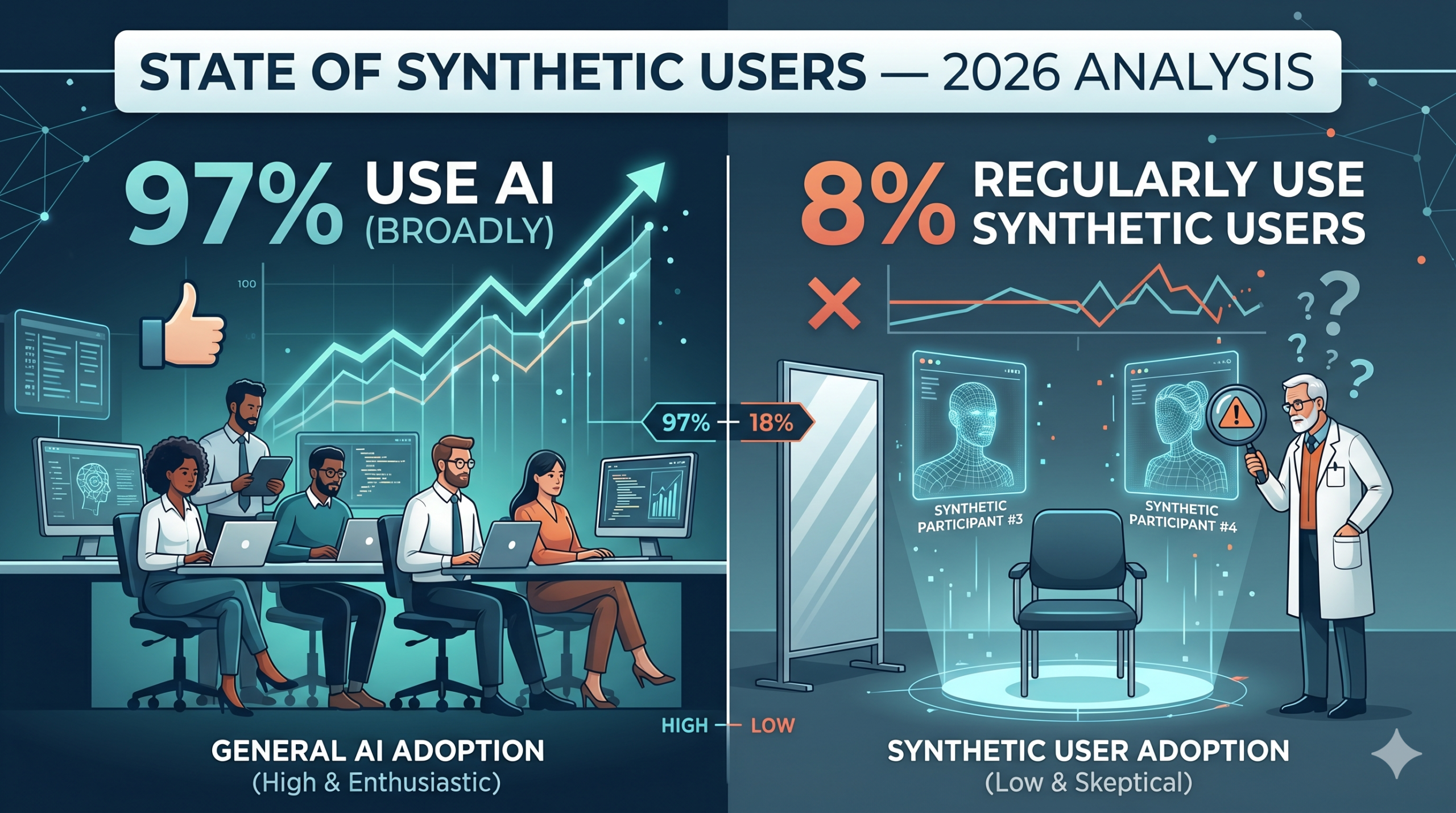
Then User Interviews asked the people who actually do this work. Its new State of Synthetic Users report surveyed 150 research professionals — 93% of them UX and user researchers, 62% inside mid-to-large enterprises — and supplemented the survey with five moderated interviews of senior practitioners. The results invert the vendor narrative. These are not AI skeptics: 97% use AI somewhere in their research workflow, and 81% use it regularly. Yet only 8% regularly use tools that generate synthetic participants. Nearly two-thirds describe themselves as skeptical or outright opposed. Not a single respondent — zero out of 150 — said they had no significant concerns.
That is not a technology adoption lag. It is an informed professional judgment, and it converges almost exactly with what the academic literature has been saying for two years. We documented those structural limitations in our analysis of the synthetic research threat: AI participants lack lived experience, exhibit hyper-accuracy distortion, carry severe geographic bias, and produce statistics that collapse under scrutiny. The practitioners and the peer-reviewed evidence now agree. The only people still claiming synthetic users can replace human research are the people selling them.
This analysis works through the User Interviews data — including the underlying anonymized dataset, which we re-tabulated independently — and connects it to the question that matters for founders, investors, and product leaders: when AI-generated research signals contaminate decision-making, who pays, and how much?
A note on methodology
The User Interviews study, designed and conducted by Roberta Dombrowski, used a two-part approach: five moderated interviews with senior practitioners to surface themes, followed by a 150-respondent survey fielded in May 2026 to quantify them. The sample skews toward experienced in-house UX researchers — 52% with 6–10 years of experience, 62% at enterprises with 500+ employees — which makes it a strong read on the practitioners enterprise buyers actually employ, and a weaker read on agencies and market research generally. Percentages in this analysis are computed from the published anonymized dataset (n = 150) and may differ from the report’s rounded figures by a point in places. Where the dataset and the report diverge, we use the dataset.
The Adoption Chasm: Near-Universal AI, Near-Zero Synthetic Users
Start with the number that destroys the “Luddite researcher” framing. Among the 150 respondents, 97% have used AI tools in their research workflow — for synthesis, transcription, analysis, planning, and thematic coding — and 81% use AI regularly. This is one of the most AI-saturated professional populations you will find anywhere in the enterprise.
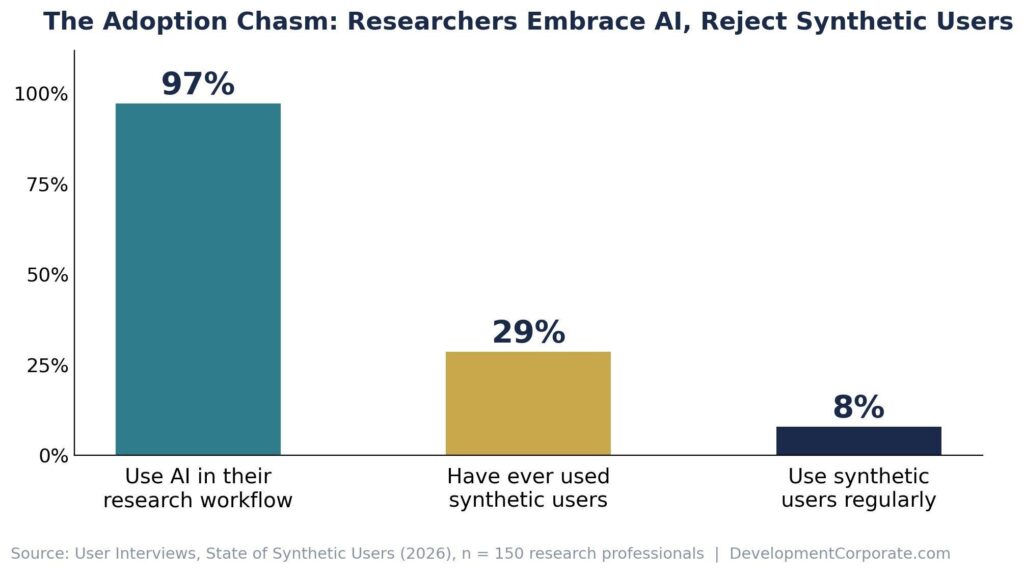
Figure 1: Researchers have embraced AI broadly while deliberately holding the line on synthetic users. Source: User Interviews State of Synthetic Users, 2026.
Synthetic-participant tools are the exception. Re-tabulating the raw dataset: 28% of respondents have never used them and actively choose not to — the single largest group. Another 25% have not considered them, 18% have seriously considered but not adopted, 21% experimented once or twice, and just 8% use them regularly. Total lifetime trial sits at 29%. For a technology that has been marketed aggressively into this exact buyer base for three years, that is a stunning rejection rate.
The composition of the non-adopters matters more than the topline. “Actively choose not to” is a stance, not an awareness gap: 96% of respondents had heard of synthetic users, and 64% had either researched the topic themselves or follow it closely. The market’s standard response to slow adoption — more education, more content, more webinars — will not move a population that has already done the homework and reached a verdict. This mirrors the pattern we found in our own synthetic CEO persona study on the AI research trust gap, where 83% of simulated enterprise software leaders required human validation before trusting AI-generated insights. Even the synthetic personas don’t trust synthetic research unsupervised.
Synthetic User Sentiment: Skepticism Is the Majority Position
Asked to describe their overall feeling about synthetic users in research, 47% of respondents chose “skeptical — I’d want to see a lot more evidence before trusting them,” and another 17% chose “opposed — I don’t think they should be used in research practice.” Combined, 64% of the profession sits on the negative side of the ledger. Cautious optimism claims 24%, neutrality 9%, and genuine enthusiasm just 3.3% — five people out of 150.
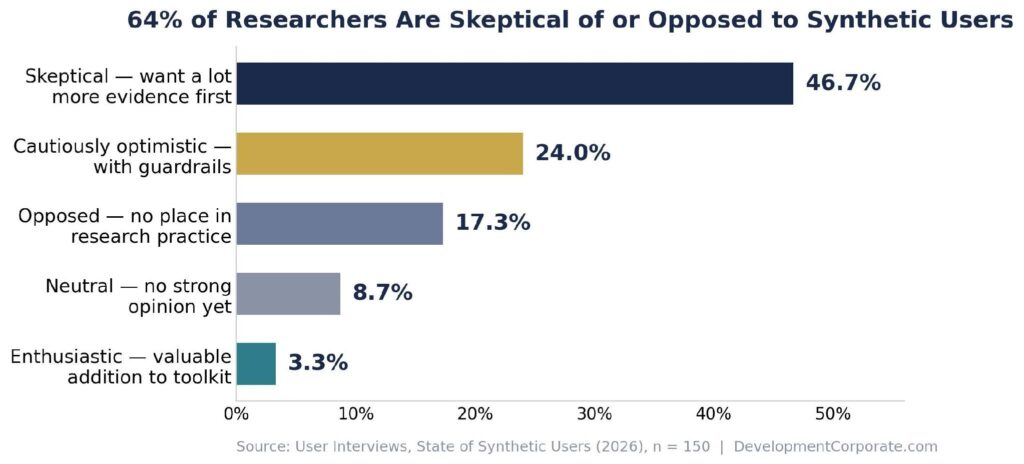
Figure 2: Overall sentiment toward synthetic users among 150 research professionals. Source: User Interviews State of Synthetic Users, 2026.
Even the language has stabilized faster than the trust. Seventy-six percent of respondents use the term “synthetic users,” with “artificial users,” “AI personas,” and “simulated participants” splitting the remainder. When a market settles its vocabulary before it settles its policies — as we will see below, 63% of organizations have no stance at all — that is usually a sign the conversation is being driven by vendors and pundits rather than by deployment experience.
Where researchers do see legitimacy, the pattern is unmistakably upstream and low-stakes. Survey and screener design leads at 47%, followed by usability testing (35%), early discovery work (33%), concept testing (32%), and persona validation (25%). Meanwhile 21% chose “none — not appropriate in any context.” The open-ended responses are even more pointed: researchers describe acceptable use as piloting interview guides, pressure-testing screeners, and gut-checking research instruments before real participants ever see them — using the synthetic user as a stand-in for the researcher’s own QA process, not for the customer’s voice.
| Research context | % who see synthetic users as legitimate |
|---|---|
| Survey / screener design | 47% |
| Usability testing | 35% |
| Early discovery / generative research | 33% |
| Concept testing | 32% |
| Persona validation | 25% |
| None — not appropriate in any context | 21% |
Table 1: Contexts where researchers see synthetic users as a legitimate tool (multi-select, n = 150). Source: User Interviews dataset, DevelopmentCorporate tabulation.
The “most appropriate role” question confirms the ceiling. Forty-one percent see synthetic users as a preliminary tool for early-stage work before human research begins, 29% as a supplement combined with human research, and 11% as a validation tool for pressure-testing human findings. Exactly one respondent — 0.7% — endorsed synthetic users as a standalone tool valid without human participants. That is the entire addressable market for the “replace your research panel” pitch: one person.
The Trust Problem: Concerns Are Social, Not Just Technical
The concern data is where this report earns its place in a board deck. Quality and accuracy of insights leads, cited by 89% of respondents. But the next two concerns are not about the model at all — they are about the humans around the model. Eighty percent worry about stakeholders over-trusting AI-generated findings, and 78% worry about synthetic data amplifying bias against underrepresented groups.
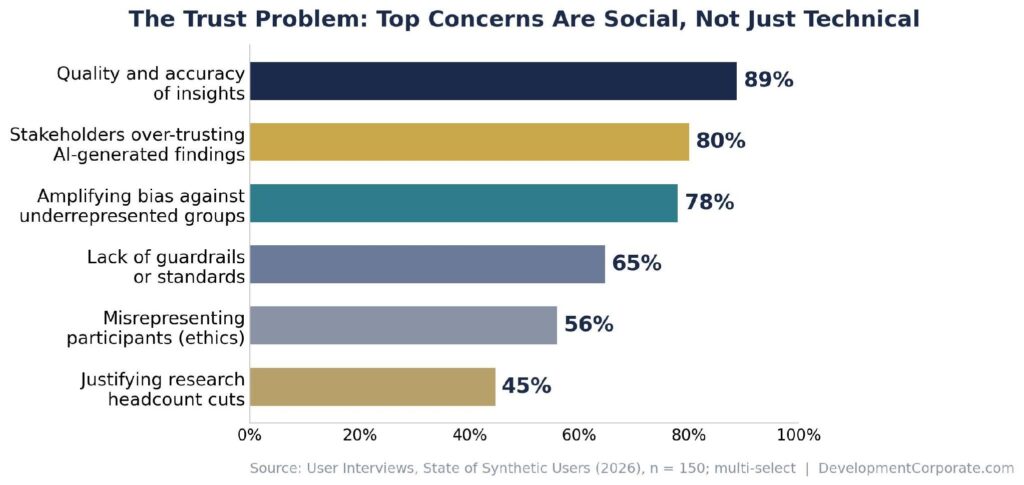
Figure 3: Biggest concerns about synthetic users in research (multi-select, n = 150). Source: User Interviews dataset, DevelopmentCorporate tabulation.
Read that second bar carefully, because it describes a principal-agent problem, not a technology problem. Researchers are not primarily afraid the AI will be wrong. They are afraid it will be wrong convincingly — that an executive who never wanted to fund research in the first place will treat fluent synthetic output as equivalent to validated customer evidence, skip the human study, and ship. One respondent in the open-ended data put it precisely: stakeholders who already undervalue research “may view this as more reliable or trustworthy than it is.” Another senior practitioner interviewed for the report worried about synthetic users creating echo chambers that reverberate their own training data while missing outlier perspectives entirely.
This is the same failure mode we documented in AI hallucination rates as a due diligence crisis: the gap between how reliable AI output looks and how reliable it is becomes most dangerous when the output feeds downstream decisions made by people who cannot audit it. In M&A workflows, hallucinations compound at machine speed. In product organizations, over-trusted synthetic research compounds at roadmap speed — each “validated” feature decision building on the last.
Also notable: 45% of researchers flagged the risk that synthetic users will be used to justify cutting research headcount. That concern is rational — and it cuts both ways for buyers of these tools. A vendor pitch whose implicit ROI case is “replace researchers” is selling into a user base that views the product as an existential threat. Adoption motions that require champion enthusiasm do not survive that dynamic.
Why Researcher Skepticism Is Evidence, Not Resistance
It would be easy to dismiss 64% negative sentiment as professional self-preservation. The problem with that dismissal is that the peer-reviewed literature independently validates nearly every concern in the survey. Our earlier deep-dive into the critical limitations of synthetic panels synthesized the academic record; the User Interviews report cites a systematic review by Kuric, Demcak, and Krajcovic spanning 182 studies that reaches the same destination. Five structural limitations recur.
1. No lived experience, no context
Carnegie Mellon researchers who interviewed qualitative researchers about AI-generated interview responses found that the output sounds plausible while lacking real-world grounding. The Kuric review frames the limitation as structural rather than temporary: large language models are predictors of plausible text, not embodied beings with sensory experience or memory-as-history. An LLM has never fought a procurement committee, never burned political capital pushing a tool purchase, never hit a budget freeze in Q4. For B2B SaaS research, those are precisely the dynamics that determine whether a deal closes.
2. Hyper-accuracy distortion
Research replicating classic psychology experiments with LLMs found that models give suspiciously perfect, low-variance answers where real humans are noisy, uncertain, and inconsistent. In a research context, that distortion manifests as falsely precise validation — clean signal where the real market would have given you mess. Several survey respondents identified this independently, noting that synthetic responses regress to the average and never produce the surprising outlier behavior that makes qualitative research valuable.
3. Severe geographic and cultural bias
When researchers benchmarked LLM responses against the World Values Survey, accuracy held for Western, English-speaking, wealthy countries and degraded sharply everywhere else. If your expansion thesis runs through Latin America or Southeast Asia, synthetic participants will systematically mislead you about regional requirements, payment preferences, and privacy expectations — and the 78% of surveyed researchers worried about bias amplification are describing exactly this failure.
4. The statistics fall apart under scrutiny
Research comparing AI-generated survey responses to a gold-standard political survey found that headline numbers looked similar while the underlying statistics were broken: variance too tight, roughly half the between-variable correlations wrong, results unstable across prompt phrasing and timing. Translation for operators: synthetic samples cannot support pricing decisions, demand forecasting, or any analysis that depends on statistical reliability — no matter how large the synthetic n.
5. Even the legitimate use cases are narrow
The research consensus, which we unpacked in our review of synthetic panels in qualitative research, is that AI participants help with messy early-stage work — drafting interview guides, testing survey wording, exploring edge-case scenarios — and cannot replace humans when you need actual experience, context, or decision-grade evidence. Notice the convergence: the academic consensus and the practitioner survey independently arrive at the same narrow, upstream, supplementary role. When two unrelated evidence bases triangulate to the same boundary, treat the boundary as real.
The fraud convergence: limitations weaponized
There is a darker corollary that the User Interviews survey did not ask about but that completes the risk picture. Our synthetic research threat analysis documented two converging dangers: legitimate synthetic panels with the structural flaws above, and malicious synthetic participants — AI-operated fake humans infiltrating real research panels for profit. The 404 Media exposé of Doublespeed, an a16z-backed startup orchestrating thousands of synthetic social media accounts on physical devices designed to evade detection, demonstrated that the persona-fabrication technology already exists at commercial scale.
The economics map directly onto research panels. B2B user interviews pay $100–$200 per hour; a single operator running dozens of synthetic professional personas could clear $90,000 per month against platforms whose fraud defenses — self-reported screeners, LinkedIn checks, video calls — were designed for human-scale cheating. And here is the convergence: the limitations that make legitimate synthetic panels unreliable become camouflage when exploited maliciously. Hyper-accuracy distortion becomes the participant who tells you exactly what you hoped to hear. The absence of lived experience hides behind plausible scripted answers. Even at 5–10% panel contamination, researchers have no way to know which insights are real — the entire dataset becomes suspect.
For platforms like UserTesting — which acquired User Interviews and now spans both human recruiting and AI-assisted research — this is the strategic squeeze: invest heavily in synthetic-participant detection, pivot toward smaller verified panels, or watch trust erode. The irony of the report itself is instructive: a human-recruiting platform publishing evidence that its customers overwhelmingly reject the synthetic alternative is both genuinely useful research and a perfectly aimed competitive document. Both things can be true; the dataset is public, and the numbers replicate.
The Governance Vacuum: 63% of Organizations Have No Policy
Here is the finding that should worry acquirers and investors more than any sentiment number: 63% of researchers report that their organization has no stance on synthetic users at all — the decision is left to individual researchers. Another 15% don’t know whether a policy exists, which is functionally the same thing. Only 11% have any formal policy, split between organizations that govern use (7%) and organizations that restrict or prohibit it (5%).
| Organizational stance on synthetic users | % of respondents |
|---|---|
| No org-level stance — left to individual researchers | 62% |
| Don’t know | 15% |
| Used informally, no formal policy | 11% |
| Formal policy governing their use | 7% |
| Formal policy restricting or prohibiting use | 5% |
Table 2: Organizational governance of synthetic users (n = 150). Source: User Interviews dataset, DevelopmentCorporate tabulation.
Combine the two halves of the dataset and the risk profile becomes explicit. Twenty-nine percent of researchers have used synthetic-participant tools at least once. Sixty-three percent operate with no organizational guidance. That overlap means synthetic data is already flowing into enterprise insight pipelines — informally, undocumented, and ungoverned — inside companies whose boards believe their product decisions rest on validated human research. One respondent flagged an additional time bomb: emerging EU AI regulation may not accept synthetic insights at all, turning today’s informal shortcut into tomorrow’s compliance exposure.
For anyone running diligence on a SaaS target, this is now a checklist item. The question “what does your customer research process look like?” needs a follow-up: “what fraction of the evidence behind your roadmap, pricing, and TAM claims involved AI-generated participants, and under what policy?” In most organizations today, nobody can answer it — which is itself the answer.
The valuation math makes the stakes concrete. Consider a Series B SaaS company whose roadmap rests on a “validated” feature thesis, where a quarter of the supporting research quietly used synthetic participants under no policy. If the hyper-accuracy distortion documented above inflated apparent demand even modestly, the company has been allocating engineering capital — often its single largest expense line — against signal that real buyers never generated. For an acquirer paying a revenue multiple on growth assumptions derived from that roadmap, the contamination flows straight into the purchase price. Research provenance is not a compliance nicety; it is an input to enterprise value, in exactly the way data provenance and model dependency already are in AI-product diligence. The companies that can show a clean evidence chain will command the benefit of the doubt. The ones that cannot will watch diligence teams apply a haircut to every customer-evidence claim in the deck.
The Narrow Path: Where Synthetic Users Actually Earn a Place
None of this means the technology is worthless. It means the value is real but small, and the marketing is large. The data sketches the defensible deployment pattern clearly: 41% of researchers accept synthetic users as a preliminary tool and 29% as a supplement — 70% combined support for a bounded, upstream, human-anchored role. That is consistent with the hybrid framework we laid out in the Sandwich Method for B2B SaaS research: synthetic breadth on the outside, human depth in the middle, and never the reverse.
In practice, the evidence supports four uses:
- Instrument QA. Pilot interview guides, stress-test screener logic, and catch ambiguous survey wording before burning real participant sessions — the single most endorsed use in the survey data.
- Hypothesis generation. Explore edge cases, draft persona hypotheses, and pressure-test positioning before committing recruiting budget — then validate everything that matters with humans.
- Triangulation. Use synthetic responses as one cheap, fast signal alongside product analytics, win/loss interviews, and direct customer relationships — never as the deciding vote.
- Team training. Simulated skeptical buyers for objection-handling practice and interviewer training, where the absence of a real human is the point.
The disqualified list is equally clear: pricing studies, demand forecasting, product-market-fit validation, and any decision with real capital behind it. In our own AI-accelerated PMF validation work, synthetic cohorts are used to design and sharpen the study — the PMF signal itself comes from real buyers, because the Sean Ellis question only means something when a human with budget authority answers it. Likewise, the highest-ROI qualitative research a founder can run remains structured win/loss analysis with actual buyers — evidence that is, by construction, impossible to synthesize, because the entire value is in what real decision-makers actually did.
There is also a vendor-narrative lesson here. As we argued in our analysis of synthetic responses in market research: promise vs. reality, the loudest adoption statistics in this category come from platforms with synthetic products to sell. The User Interviews data — gathered from practitioners, published with the raw dataset, by a company whose core business is recruiting real humans — carries its own incentive structure, to be fair. But its findings align with independent academic work in a way the vendor claims do not. When in doubt, weight the evidence that survives an incentives audit.
What This Means for Investors, Founders, and Product Leaders
| For PE and VC InvestorsAdd research provenance to diligence. With 63% of organizations lacking any synthetic-user policy, assume some fraction of a target’s “validated” customer evidence is AI-generated until proven otherwise. Ask for the policy, the audit trail, and the human-validation ratio behind roadmap and TAM claims.Discount synthetic-research category bets. A market where 8% of practitioners are regular users, 3% are enthusiastic, and the modal buyer actively chooses not to adopt is not an adoption curve — it is a verdict. Platforms positioned as research accelerants with human validation built in have a path; “replace your panel” positioning is selling against 92% of its own users.Watch the regulatory tail. EU AI Act treatment of synthetic insights could convert informal usage inside portfolio companies into disclosure and compliance exposure. |
| For SaaS Founders Approaching ExitDocument your research provenance now. Acquirers are beginning to ask how customer evidence was generated. A clean, written policy — synthetic for instrument design and exploration, humans for all decision-grade validation — is cheap to adopt today and expensive to retrofit during diligence.Never let synthetic data near pricing or PMF claims. The statistical reliability research is unambiguous: variance and correlations in synthetic samples are broken. An investor who discovers your willingness-to-pay analysis ran on AI respondents will reprice the entire evidence base of your deck.Use the 70% consensus position. Preliminary plus supplementary use is where practitioners, academics, and acquirers all agree. Stay inside that boundary and synthetic tools genuinely extend runway; step outside it and they manufacture false confidence at the worst possible moments. |
| For Enterprise CTOs and CPOsClose the governance vacuum before procurement does. If 63% of organizations have no stance, an ungoverned tool is almost certainly already inside your insight pipeline. A one-page policy — approved uses, prohibited uses, labeling requirements, human-validation thresholds — eliminates most of the risk at near-zero cost.Mandate labeling. The top practitioner fear is stakeholder over-trust. Require every artifact containing synthetic-participant data to be labeled as such, end to end, so no executive ever mistakes simulated feedback for customer evidence.Protect the research function. Forty-five percent of researchers expect synthetic users to be used as headcount-cut justification. Teams that fear replacement will not honestly evaluate the tools — position synthetic capacity explicitly as instrument QA and exploration capacity, not researcher substitution. |
The Bottom Line
The State of Synthetic Users report is the clearest practitioner-side evidence yet that the synthetic research category has been valued on its narrative rather than its deployment reality. The 89-point gap between AI adoption (97%) and regular synthetic-user adoption (8%) is not a lag waiting to close with better models. It reflects structural limitations — no lived experience, distorted statistics, cultural bias, over-trust dynamics — that practitioners observe daily and academics have now measured repeatedly.
The winning posture for operators is neither embrace nor prohibition. It is governance: synthetic users for instrument design, exploration, and training; verified humans for every decision that moves money; written policy and labeling in between; and a documented provenance trail that survives diligence. The companies that get this right will make better product decisions than competitors over-trusting cheap synthetic signal — and they will sail through an acquirer’s research-provenance questions that are, on this evidence, about to become standard.
The market settled on a name for these tools faster than it settled on rules for them. The 150 professionals in this dataset just published the rules. The only question is who reads them before their next roadmap decision — or their next deal.
Frequently Asked Questions About Synthetic Users
What are synthetic users?
Synthetic users are AI-generated personas — typically powered by large language models trained or prompted with demographic, behavioral, and persona data — that simulate research participants in place of recruited humans. Seventy-six percent of researchers now use the term “synthetic users,” though “artificial users,” “AI personas,” and “simulated participants” remain in circulation.
How many researchers actually use synthetic users?
According to the 2026 User Interviews State of Synthetic Users report, 8% of research professionals use synthetic-user tools regularly and 21% have experimented once or twice — against 97% who use AI elsewhere in their research workflow. The largest single group, 28%, actively chooses not to use them.
Can synthetic users replace human research participants?
No. Peer-reviewed research shows synthetic participants lack lived experience, produce unrealistically consistent answers, carry strong Western-market bias, and generate statistically unreliable data — and 99.3% of surveyed researchers reject standalone synthetic use. The defensible role is upstream and supplementary: instrument design, piloting, and hypothesis generation, always validated with real humans before decisions.
What should companies do about synthetic users right now?
Write a policy. Sixty-three percent of organizations currently have no stance, which means ungoverned synthetic data is likely already entering insight pipelines. A one-page policy defining approved uses, prohibited uses, mandatory labeling, and human-validation thresholds closes most of the exposure — and creates the research-provenance documentation that investors and acquirers are starting to request in diligence.
About the Author
John C. Mecke is Managing Director of DevelopmentCorporate LLC, an enterprise SaaS M&A advisory firm. He has more than 30 years of experience in enterprise software go-to-market, product strategy, and corporate development. DevelopmentCorporate publishes data-driven analysis on SaaS valuations, AI due diligence, and research integrity at DevelopmentCorporate.com.