
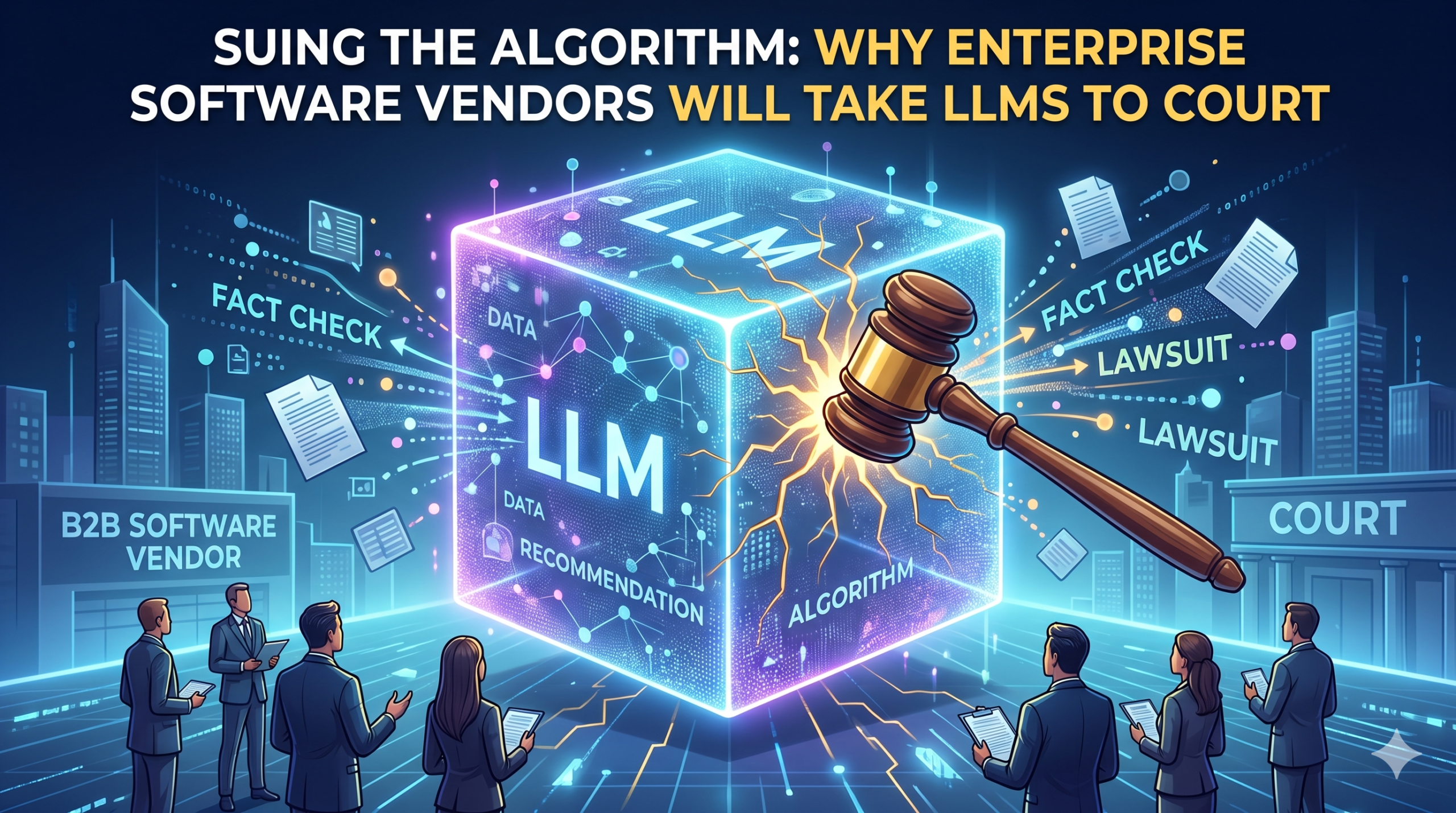
Suing the Algorithm
Why Enterprise Software Vendors Will Take LLMs to Court — and What They Should Do Instead
“Thirty-five percent of enterprise software vendors are eliminated from buyer consideration sets not by a competitor’s superior product — but because an LLM simply failed to surface them. The business harm is real. The lawsuits are coming.”
The Stakes Are No Longer Theoretical
New proprietary analysis from DevelopmentCorporate LLC estimates that approximately 172 million B2B enterprise software queries are executed every single day — distributed across Google, ChatGPT, Gemini, Claude, and Grok. That is not a rounding error or a speculative projection. It is a structural reality of how enterprise software buyers operate in 2026. They are using large language models to build vendor long-lists, compare capabilities, and eliminate options before your CRM registers a single touch.
The downstream consequences of this shift are documented in DevelopmentCorporate’s Enterprise Software Buyer Behavior Study (N=250 pre-seed and seed-stage SaaS executives, April 2026). The findings are stark. Thirty-eight percent of buyers begin their evaluation with a long-list of five to seven vendors. By the time human engagement begins, fifty-four percent have already narrowed their consideration set to just two or three vendors. And thirty-five percent of vendors are eliminated at the long-list stage not by a competitor’s superior messaging or pricing — but explicitly because an LLM failed to surface them. The buyer moved on without the vendor ever knowing they were in the running.
When a technology causes this magnitude of business harm — eliminating companies from competitive consideration before a single conversation occurs — lawyers pay attention. We are now at the beginning of a period in which enterprise software vendors will begin testing the legal system’s appetite for holding LLM providers accountable. The first wave of cases will be filed by companies that feel they have been unfairly excluded, inaccurately described, or systematically disadvantaged by AI-generated recommendations they cannot audit, contest, or even observe.
Understanding whether those cases can succeed requires starting not with AI law — which barely exists — but with the twenty-year legal history of how courts treated another technology that once felt equally transformative and equally opaque: the search engine algorithm.
The Search Engine Precedents That Built the Safe Harbor
When Google began to dominate web search in the early 2000s, businesses that found themselves buried in rankings — or removed entirely — did exactly what any commercially harmed party does. They sued. Three cases defined the legal framework that has protected search engines ever since, and their logic will be the starting point for every LLM dispute that follows.
In Search King, Inc. v. Google Technology, Inc. (2003), the plaintiff argued that Google had deliberately delisted its site in retaliation for competing with Google’s advertising business. The court dismissed the case on a ground that would become foundational: search results are editorial opinions, not statements of fact. Because they are opinions, they are protected by the First Amendment. You cannot defame someone with an opinion. You cannot sue a publisher for the opinions it chooses to express.
Kinderstart.com, LLC v. Google, Inc. (2006) reinforced this framework from a different angle. Kinderstart had experienced a seventy percent traffic drop after Google adjusted its PageRank score and argued that Google had artificially manipulated the ranking without justification. The court held that search engines have no obligation to include or rank sites in any particular way. There is no contractual relationship between a website owner and a search engine. You are not owed a ranking any more than a retail store is owed shelf space in a competitor’s building.
Langdon v. Google, Inc. (2007) completed the trilogy by addressing antitrust and First Amendment angles simultaneously. The court held that Google is a private entity with the right to determine its own editorial content. Taken together, the three cases created what amounts to a common-law safe harbor built on three pillars: editorial discretion (the rankings are judgment calls, not neutral data), absence of contractual obligation (no company is owed visibility), and the opinion defense (algorithmic outputs are inherently subjective and therefore not provably false).
For two decades, this framework has held. Every attempt to challenge Google’s search rankings on the merits has failed — with the notable exception of the Department of Justice’s antitrust case, which succeeded not because the rankings were unfair, but because the business contracts used to maintain search dominance were anticompetitive. Ranking itself was not the violation. Market foreclosure through exclusive dealing was.
This is the legal terrain that AI companies will try to occupy. It is comfortable, well-established, and has repelled every challenger so far. The question is whether LLMs are fundamentally different enough from search engines that the precedents do not transfer cleanly.
Why LLMs Are Not Search Engines — and Why That Changes Everything
The search engine precedents rest on a specific characterization of what a search engine does: it organizes and presents existing content, making editorial judgments about relevance and authority. The search engine does not create. It curates. Its outputs point to sources that users can evaluate independently.
LLMs do something categorically different. When an enterprise software buyer asks ChatGPT or Claude to recommend the best EDI integration platform for a mid-market manufacturer, the model does not return a list of links organized by relevance score. It generates a synthesized response — a confident, first-person recommendation — that reads like advice from a knowledgeable consultant rather than a ranked directory. The buyer receives not a pointer to sources but a conclusion. And that conclusion, by its nature, includes some vendors and excludes others.
This distinction matters enormously under the legal frameworks that will govern these disputes. When an LLM states that “Company A is the leading provider in this category,” it is not expressing an algorithmic opinion about relative link authority. It is making an affirmative factual claim about market position. If that claim is demonstrably false — if Company B actually holds market leadership by every measurable metric — the search engine’s “opinion defense” may not apply with the same force. Courts will need to determine whether a generated recommendation is closer to an editorial judgment or a statement of fact.
There is also the question of authorship and control. The search engine cases established that Google did not “create” its rankings in a meaningful sense — they emerged from a mechanical process applied to user-generated content on the open web. An LLM synthesizes its outputs from training data in a way that makes the provider a much more active participant in the content being generated. Courts in Europe reached precisely this conclusion when they found Google liable for defamatory autocomplete suggestions: the reasoning was that autocomplete was something Google actively designed and controlled, making it more like an “author” of those suggestions than a “neutral host” of search results. LLM recommendations are even further along that spectrum toward authorship.
The Legal Theories That Will Be Tested
Plaintiffs’ attorneys exploring this space are not starting from a blank page. Several existing legal theories offer potential pathways, each with different evidentiary requirements and different probabilities of success.
Defamation and False Statements of Fact
This is the most immediately accessible theory and the one most likely to produce early victories. When an LLM makes affirmatively false statements about a company — incorrectly describing its product capabilities, fabricating compliance certifications, or mischaracterizing its customer base — traditional defamation law applies. Courts have already begun to address AI hallucinations in the defamation context. The first significant test was Walters v. OpenAI, LLC (2023–2025), in which Georgia radio host Mark Walters sued OpenAI after ChatGPT falsely accused him of financial fraud. The Georgia court ultimately dismissed the case on narrow grounds — specifically, that no one believed the hallucinated output and no harm was disseminated — but notably did not rule that defamation claims against LLM providers are categorically barred. The door remains open.
For enterprise software vendors, the defamation angle is most potent when an LLM produces a specific false negative — telling a buyer that a vendor lacks a particular integration, has had documented security breaches, or does not serve a specific industry vertical. These are not matters of editorial judgment. They are factual claims that can be verified or falsified. The search engine opinion defense does not straightforwardly apply because the LLM is not ranking — it is asserting.
Tortious Interference with Business Relations
This is the theory receiving the most serious attention from business litigators, and it is also the most difficult to prove. Tortious interference requires demonstrating that a third party intentionally disrupted an existing or prospective business relationship. The “intentional” element is where most cases will struggle. An LLM that fails to recommend a vendor because that vendor’s content is underrepresented in training data is not behaving intentionally — it is behaving statistically. Proving that an exclusion was deliberate rather than emergent from the model’s probabilistic architecture is an extraordinarily high evidentiary bar.
However, a narrow variant of this theory becomes more credible if plaintiffs can demonstrate that an LLM provider has systematically favored commercial partners, trained on curated data designed to advantage specific vendors, or fine-tuned its models in ways that produce consistent, non-random exclusion patterns. If the bias can be shown to be structural rather than stochastic, intentionality becomes arguable. The Datos/Semrush AI Search Gateway Report has already documented that different LLMs produce materially different vendor recommendation patterns for the same category queries — patterns that will become exhibit material in future litigation.
Unfair Competition and Undisclosed Advertising
This may ultimately be the most commercially significant legal frontier. The FTC has already signaled aggressive interest in AI disclosure requirements, extending its Endorsement Guides — revised in 2023 — to cover AI-generated content. The fundamental question is simple: if an enterprise software buyer asks an LLM for a vendor recommendation and the LLM systematically recommends vendors who have paid for visibility — through sponsored training data, preferred citation programs, or other commercial arrangements — without disclosing that commercial relationship, that recommendation is arguably an advertisement. And undisclosed advertising in a context that purports to be objective expert advice violates multiple layers of consumer protection and unfair competition law.
The practical challenge is proving the commercial relationship. LLM providers can credibly argue that their recommendations emerge from training data, not from contractual arrangements. But as AI companies develop “enterprise visibility” products, sponsored integrations, and preferential indexing programs — all of which are already being piloted — the line between organic recommendation and paid placement will become increasingly difficult to defend.
Antitrust
The antitrust angle is long-cycle but potentially decisive. If a dominant AI platform systematically favors software vendors in which its parent company or investors hold equity stakes, and if that systematic preference demonstrably forecloses market access for competitors, the legal theory is not novel. It is the same theory that ultimately succeeded against Google in the U.S. v. Google LLC search distribution case — applied to a new layer of the market. The DOJ and FTC are both actively monitoring AI platforms for precisely this pattern.
The Black Box Problem: Why These Cases Are Hard to Win
Even where legal theories are sound, the practical obstacles to winning LLM litigation are formidable. The fundamental challenge is the same one that has always protected algorithmically mediated decisions: opacity. With a search engine, you can at least observe the output — you know you are on page four when your competitor is on page one. With an LLM, the output varies with every query, depends on how the question is phrased, differs across model versions, and changes as the model is updated. There is no stable “Page 1” to point to as evidence of exclusion.
Discovery in these cases will be unlike any prior technology litigation. Plaintiffs will need to demonstrate not just that they were excluded in specific instances but that the exclusion was systematic, reproducible, and causally connected to the AI provider’s specific choices about training data, fine-tuning, and reinforcement learning from human feedback. AI companies will defend their model weights, training data composition, and fine-tuning processes as trade secrets. Courts will need to develop entirely new frameworks for how to conduct discovery into probabilistic systems.
There is also the baseline problem. To prove tortious interference or unfair competition, a plaintiff needs to demonstrate that they would have been recommended “but for” the defendant’s wrongful conduct. But how do you establish the counterfactual recommendation set of an LLM? You cannot run a controlled experiment. You cannot compare the model’s output to what it “should have” produced without introducing a subjective standard that defendants will attack as arbitrary. This is a fundamental evidentiary challenge that plaintiffs’ experts will struggle to address convincingly.
DevelopmentCorporate’s LLM Training Data Audit framework — which systematically tests how ChatGPT, Claude, Gemini, Grok, and Perplexity characterize specific vendors across identical prompts — illustrates both the opportunity and the evidentiary difficulty. The same company can be described as a “leading provider” in one LLM and not mentioned at all in another. Proving that either outcome was the product of wrongful conduct rather than training data variance is the challenge that will defeat most early cases.
The statute of limitations presents a further complication. When exactly does an LLM “exclude” a vendor? Is it at the moment the training data was assembled? At the moment the model was deployed? Each time a query is processed? The answer matters enormously for determining when a claim accrues and how long plaintiffs have to file.
Where Courts Will Draw Different Lines
Despite these obstacles, there are specific categories of LLM behavior that courts will treat more harshly than the search engine precedents would suggest. Three fault lines are worth watching.
First: affirmative factual errors. When an LLM hallucinates a vendor’s capabilities, fabricates product specifications, or invents a security incident, it is not making a ranking judgment. It is making a false factual claim. The search engine opinion defense does not shield false facts, and courts will not extend it to do so. The Walters v. OpenAI dismissal was decided on narrow factual grounds — no dissemination, no damages. A case with actual business impact — a buyer who declined to evaluate a vendor based on an LLM-hallucinated compliance failure, for instance — would present a substantially stronger fact pattern.
Second: commercial relationships masquerading as neutral recommendations. As the FTC and EU AI Act enforcement bodies develop disclosure requirements, LLM providers who fail to flag paid or preferential placement in their outputs will face regulatory action that will run parallel to, and potentially enable, private civil litigation.
Third: vertical integration conflicts. When an LLM provider’s parent company competes directly in the enterprise software markets that its AI is being asked to evaluate — cloud infrastructure, productivity software, CRM, or analytics — the potential for structural bias is not speculative. It is architectural. Plaintiffs who can demonstrate that an LLM systematically favors the parent company’s software ecosystem will find antitrust and unfair competition courts considerably more receptive than the courts that dismissed the Search King and Kinderstart cases.
The Regulatory Layer That Changes the Calculus
Private litigation is only one dimension of the coming accountability reckoning. The regulatory environment is moving faster than the courts, and regulatory action has historically reshaped the litigation landscape by establishing standards of care that plaintiffs can then use to demonstrate negligence.
The EU AI Act, now in phased enforcement, classifies certain AI systems as high-risk and mandates transparency, human oversight, and technical documentation. While enterprise software recommendation is not currently a designated high-risk category, the pressure to expand that classification is significant. European businesses that feel systematically excluded from AI-generated vendor recommendations will have regulatory channels that their American counterparts currently lack.
In the United States, the FTC’s AI and algorithmic accountability agenda is the most immediate regulatory pressure point. The FTC has already issued guidance on AI endorsements and reviews, extending its Endorsement Guides requirements to AI-generated content. As that guidance develops into formal rulemaking, LLM providers who produce commercially influenced recommendations without disclosure will face not just civil suits but administrative enforcement.
The practical implication for enterprise software companies is that regulatory pressure will likely produce disclosure requirements and technical auditing standards before private litigation produces precedent-setting verdicts. Companies should be tracking the regulatory calendar as carefully as they track the litigation docket.
What Enterprise Software Vendors Should Actually Do
Given the legal landscape as it currently stands — and as it is likely to develop over the next three to five years — litigation is not a viable primary strategy for most enterprise software vendors feeling the effects of LLM invisibility. The cases are expensive, slow, and face genuine doctrinal uncertainty. More fundamentally, even a successful lawsuit does not restore your visibility in the AI systems that buyers are using today to make decisions.
The strategic response that actually works operates in parallel across several dimensions, and the first is foundational: ungated, structured, original content is the highest-ROI investment available to any enterprise software company operating in the current environment. LLMs cannot access content that requires authentication. The most prestigious analyst reports in your category — the Gartner Magic Quadrant recognition or Forrester Wave placement your VP of Sales celebrates in board meetings — generate zero LLM training signal because they are paywalled. As DevelopmentCorporate’s LLM training data research confirms: paywalled content is universally blocked across ChatGPT, Claude, Gemini, Grok, and Perplexity. The ungated derivative content you publish about analyst recognition matters more for LLM visibility than the recognition itself.
Third-party citation authority is the second critical lever. Crunchbase, Business Wire, and G2 are among the highest-verified LLM citation sources for enterprise software vendors. Review volume on G2 is not just a sales enablement asset — it is LLM training data. Companies that have invested in systematic review generation are building a citation footprint that influences how models characterize their market position years from now.
Original research is the third dimension — and the one most underinvested by early-stage companies. When your company publishes a rigorous, methodologically sound study of buyer behavior, pricing benchmarks, or technology adoption in your category, you create precisely the kind of high-authority, ungated content that LLMs weight heavily in training. This is not content marketing in the traditional sense. It is knowledge infrastructure — content that establishes your company as a source of record in your domain, the kind of source an LLM is trained to cite when a buyer asks a category question.
Finally, a structured LLM Training Data Audit should be on every enterprise software company’s 2026 operating agenda. Understanding how each major LLM currently characterizes your company, your category, and your competitors — and identifying the specific gaps in your content coverage that produce those characterizations — is now a strategic planning input, not a marketing experiment. The AI Dark Funnel research is unambiguous: 94% of enterprise buyers now use LLMs at some point in a software purchase, and the content they encounter shapes not only vendor selection but category understanding and evaluation criteria. The companies conducting these audits today are building the GEO roadmaps that will determine their AI visibility over the next eighteen to thirty-six months.
The Decade of AI Accountability Is Beginning
The lawsuits are coming. Some will be filed by companies with genuine grievances — vendors who can document material, AI-generated falsehoods that influenced buyer decisions, or who can demonstrate systematic exclusion patterns that go well beyond the statistical noise of probabilistic recommendation. A small number of those cases will succeed, and when they do, they will reshape the disclosure requirements and technical standards that govern how AI recommendation systems operate.
Many more will fail, for the same reasons that three decades of search engine litigation failed: the editorial discretion doctrine, the absence of contractual obligation, and the near-impossible evidentiary burden of proving intentional, causally attributable harm from a probabilistic system guarded by trade secret law. The safe harbor that courts built in Search King, Kinderstart, and Langdon will not be imported wholesale into AI law, but it will exert significant gravitational pull on every LLM dispute that reaches a federal court in the next five years.
The enterprise software vendors that will actually win in this environment are not the ones who hire litigation counsel to challenge their AI invisibility. They are the ones who recognize that 172 million daily queries represent an opportunity as much as a threat — and who invest now in the content infrastructure, citation authority, and structured LLM visibility that turns an opaque, inaccessible algorithm into a durable competitive advantage.
GEO is not a replacement for SEO. It is the next layer of the same compounding asset. The companies that built domain authority early won the last decade of search. The companies building LLM citation authority now will win the next one. Whether the courts ultimately reign in AI recommendation systems or not, that compounding advantage will have been earned either way.
About the Author: John Mecke is the Managing Director of DevelopmentCorporate LLC, a boutique B2B SaaS consulting firm based in Costa Rica serving US and international clients. His practice focuses on pre-seed and seed-stage enterprise software founders, offering competitive intelligence, GEO/LLM visibility auditing, research-driven demand generation, win/loss analysis, ICP/PMF validation, and pricing studies. He has held executive roles at KnowledgeWare and Sterling Software, with 30+ years in enterprise software.