The Customer Insight Infrastructure Gap:
Why 73% of SaaS Companies Are Making Decisions Without the Evidence They Think They Have
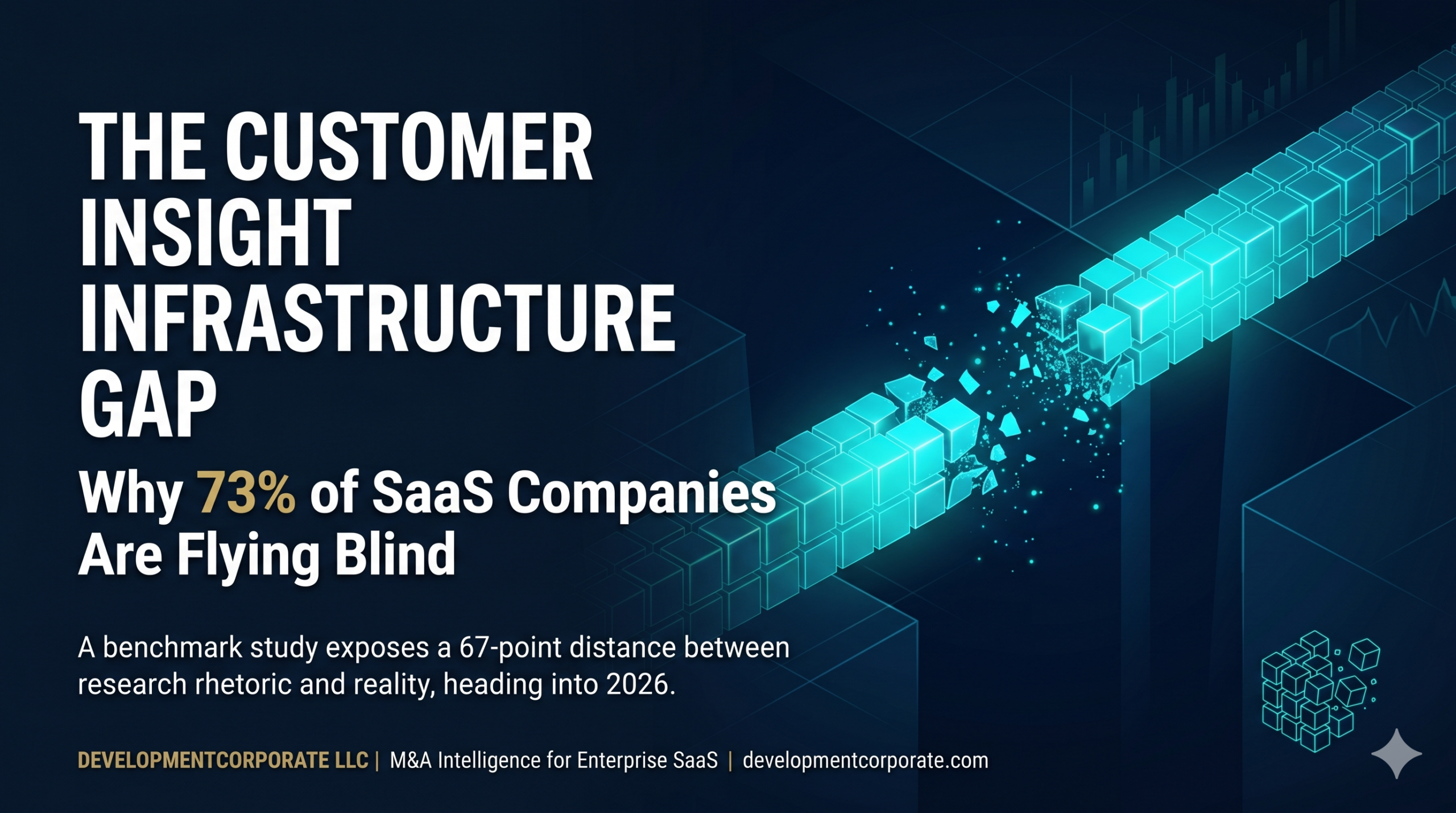
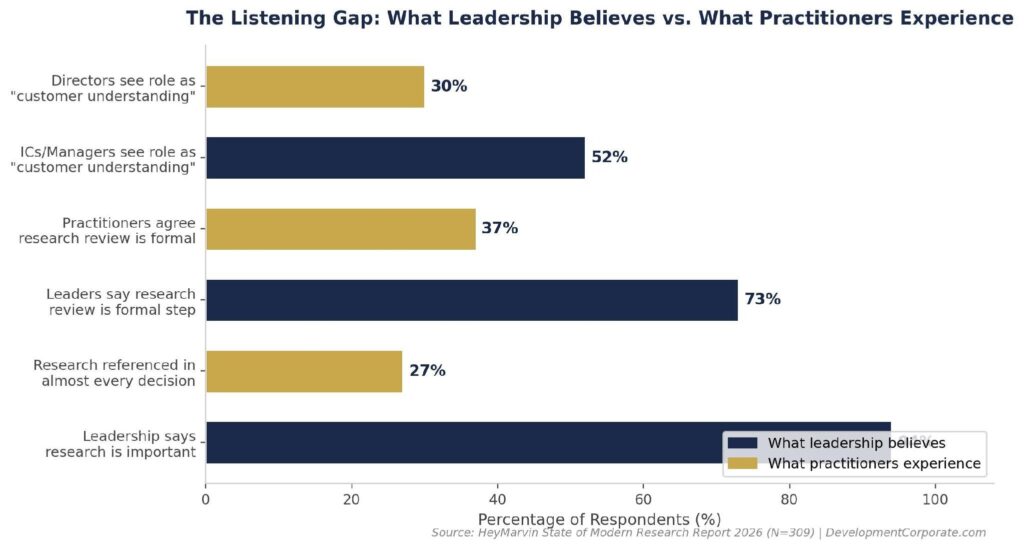
Customer insight infrastructure is quietly becoming one of the most consequential — and most underexamined — factors in enterprise SaaS valuation. A new benchmark study from HeyMarvin surveyed 309 researchers, research consumers, and research leaders across industries and company sizes. The findings expose a contradiction at the heart of most organizations: 94% report that leadership considers research important, yet only 27% say their company actually references research in almost every major decision. That 67-point gap — the distance between research rhetoric and research reality — is the defining strategic vulnerability for enterprise software companies heading into 2026.
| “Most companies say they listen to their customers. The truth is more complicated. Only 27% reference research in almost every major decision.” — HeyMarvin State of Modern Research Report 2026 |
The Listening Gap: A 67-Point Disconnect
The listening gap is real, measurable, and — based on this data — getting worse. It is not merely a cultural issue. It is a structural one. HeyMarvin defines it as the distance between leaders wanting more customer research and that research actually showing up in rooms where decisions get made. The data behind this gap is precise enough to be uncomfortable.
73% of director-level respondents say reviewing existing research is a formal requirement before major decisions. Only 37% of individual contributors and practitioners agree. This is not a minor perceptual difference. It means leaders believe a formal process exists that practitioners say does not. The real-world implication: leaders are making decisions they think are evidence-informed, when in practice they are not.
The causes of this gap split along predictable fault lines. Senior leaders cite infrastructure: knowledge fragmented across too many tools (41%), findings too academic to act on (41%), demand outpacing capacity (39%). Practitioners cite culture and prioritization: decisions made too fast for research to inform them (37%), insights treated as nice-to-have (32%), being regularly asked to validate decisions already made (29%).
Both camps are right. And that duality is precisely why the listening gap is so persistent. You cannot fix a culture problem with better tooling alone, and better culture won’t rescue a tech stack that makes insights impossible to find. For SaaS acquirers and PE investors, this dual failure mode is directly relevant to post-acquisition integration risk and to the reliability of pre-LOI due diligence.
Research Has Scaled. The Infrastructure Has Not.
Research has become an always-on function at most enterprise organizations — but without the infrastructure to support that shift. Survey respondents report using nearly four different research methods in the past 12 months and managing that work across more than six software tools spanning 3.4 tool categories. Yet less than half (48%) maintain an active research repository or dedicated system to compile insights.
This is a classic SaaS anti-pattern: function scales, infrastructure doesn’t. The result is a research debt accumulation that looks invisible on the income statement but shows up in slower product cycles, higher mis-build rates, and churn driven by products that don’t solve what customers actually need. This connects directly to the NRR erosion patterns we track in enterprise SaaS acquisition candidates.
Only 35% of surveyed organizations run a primarily always-on research function. The other 65% operate on a project basis or with no consistent structure. Research roles are deeply embedded across marketing, product, design/UX, and engineering — but only 7% report into a standalone research function with independent authority. Mandates have outpaced the structures required to deliver on them.
| The M&A Signal Hidden in Research Fragmentation |
| When customer insight infrastructure is fragmented, three things happen that matter directly to acquisition value: |
| 1. NRR durability becomes harder to validate. If the product team cannot reliably access customer feedback, renewal risks are flying blind. |
| 2. Product roadmap credibility weakens. Research-informed roadmaps command higher acquisition multiples. Research-optional roadmaps do not. |
| 3. Post-acquisition integration is harder. Fragmented insight infrastructure is one of the leading sources of value leakage after close. |
AI Adoption Is Wide. The Gap Between Adoption and Value Is Wider.
93% of research professionals report actively using or experimenting with AI. 72% say they are saving 25% or more of their time. On the surface, this looks like a field that has figured out AI. The data underneath tells a different story.
No single AI capability is used by more than 52% of respondents. Most practitioners are reaching for general-purpose tools like ChatGPT and Claude rather than purpose-built research AI. Only one in three uses AI features built directly into research tools. The adoption is wide but shallow — a pattern we’ve documented in other agentic AI adoption contexts.
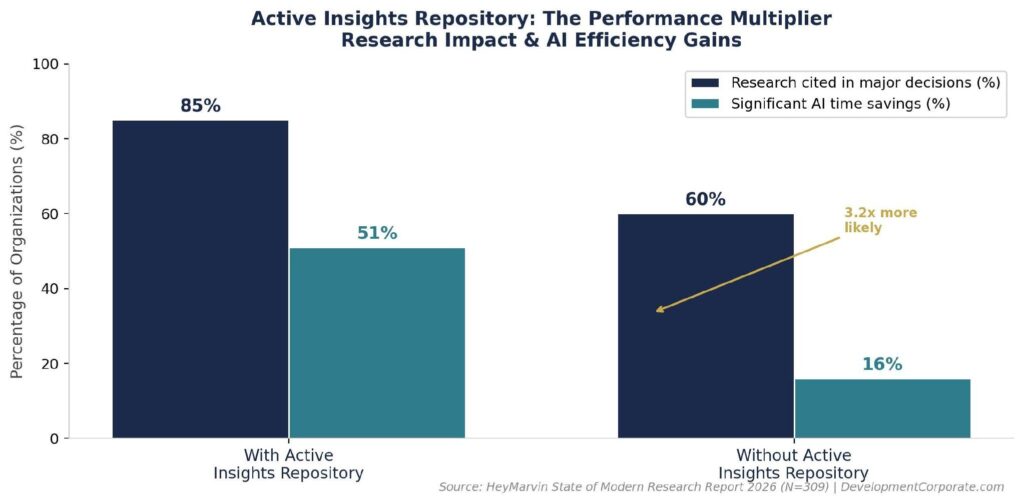
The organizations unlocking the most from AI share one structural trait: an active insights repository. Organizations with active repositories see significant AI time savings at more than three times the rate of those without one (51% vs. 16%). This is not a marginal difference. It is a structural multiplier. AI tools without grounded, verified customer data produce outputs that move faster but are not more correct. This mirrors the hallucination risk patterns we’ve flagged in AI-generated consulting reports — speed without accuracy is a liability, not an asset.
The Priorities Research Leaders Actually Have — And What They Reveal
When asked to identify their top priority for the next 12 months, 85% of research professionals ranked better measuring research impact and ROI as number one. Increasing headcount and budget ranked last. The conversation has moved: the priority is no longer producing more research, it is making existing research matter more.
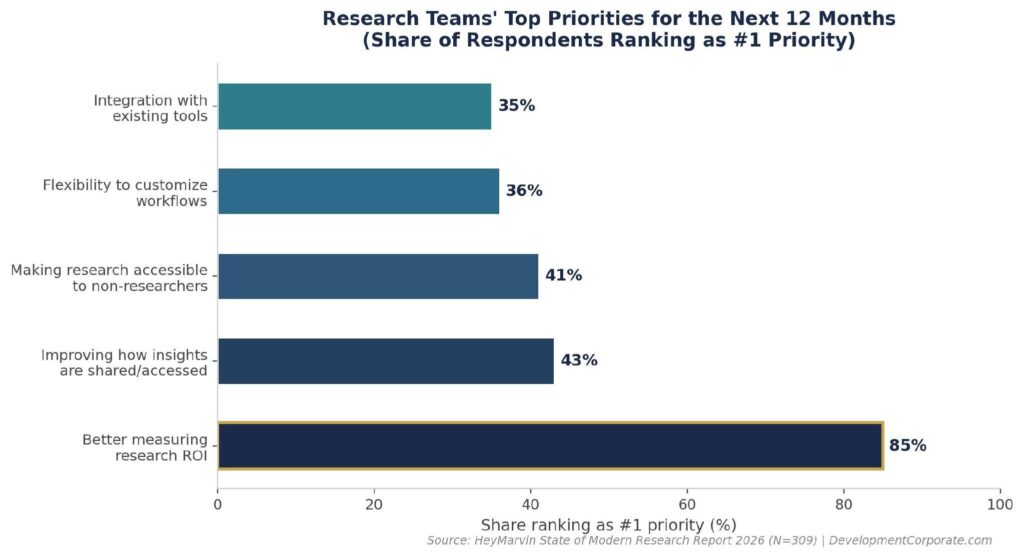
Despite impact measurement ranking as the top priority, only 47% of organizations have established KPIs for customer research. The circular trap: research lacks influence because its value is invisible, and its value is invisible because no one has defined success metrics. The organizations that have broken this cycle focus on communicating insights rather than simply collecting them.
The most effective organizations demonstrate research value in concrete terms: 50% show the time or cost savings from avoiding bad decisions, 43% track stakeholder satisfaction with research outputs, and 40% tie insights directly to specific product decisions. These are metrics that earn research a permanent role in strategic conversations — and in acquisition due diligence, they differentiate research-mature targets from research-optional ones.
The Active Repository: The Single Highest-Leverage Investment
The report’s most striking operational finding is also its simplest: organizations with active insights repositories reference research in major decisions 25 percentage points more often than those without (85% vs. 60%). At the highest threshold — research referenced in almost every major decision — the gap widens to a 4x difference (43% vs. 12%).
“Active” is the operative word. About 36% of organizations with a repository describe theirs as stagnant — and a stagnant repository produces the same outcomes as no repository at all. The organizations that close the listening gap treat their repository as a living system, not a filing cabinet. Insights are findable in seconds, not days. Research from six months ago surfaces automatically when it is relevant to a decision happening today.
Organizations with active repositories are also 2.5x more likely to track research’s influence on decisions and 2.8x more likely to have built-in effectiveness metrics. These are not coincidences. The infrastructure that makes insights findable also makes impact measurable. For SaaS founders preparing for exit, a demonstrable research-to-decision paper trail is becoming a competitive advantage in the buyer conversation.
| “The 25-point gap in how often research shows up in decisions is the starkest number in this dataset. The single highest-leverage investment most research teams could make is to make the research they already have more findable, usable, and measurable.” — HeyMarvin |
Four Traits of Organizations That Have Closed the Gap
The report identifies the organizations that have closed the listening gap and characterizes what they have in common. Not all of these are large companies — the pattern appears across company sizes. The common thread is infrastructure, not headcount.
1. An Active, Maintained Insights Repository
Research is stored, tagged, searchable, and referenced by default. The repository functions as institutional memory, not a project archive. When a stakeholder asks a question already answered by past research, the answer takes seconds — not days of archaeology.
2. Shared Metrics Between Leaders and Practitioners
Leaders and practitioners measuring different things creates the perception gap documented above. Modern research teams establish shared KPIs: research referenced in decisions, stakeholder satisfaction with research outputs, product decisions tied to specific insight sources. This mirrors the NRR/ARR alignment problem we track in acquisition diligence — if the metrics the CFO watches and the metrics the product team watches diverge, you are building toward misalignment.
3. AI Integrated Across the Full Research Workflow
Purpose-built AI used at collection, analysis, synthesis, and distribution stages — not just for transcription. The most desired capabilities reflect where AI creates the most leverage: AI-generated competitive intelligence (52% want it), real-time analysis during live interviews (48%), AI-supported research assets (43%). These are capabilities that help insights reach more people at the moment decisions are made.
4. Research Treated as Persistent Infrastructure, Not a Project
The shift from project-based to always-on research is a repositioning: research is no longer a deliverable that gets filed after the meeting, it is infrastructure the whole organization draws on continuously. Every new project builds on everything that came before it. This has direct parallels to how we think about data moats in enterprise SaaS acquisition analysis — proprietary, compounding knowledge assets are structurally defensible in ways that one-time deliverables are not.
| What This Means For Your Organization | ||
| PE/VC InvestorsCustomer insight infrastructure is now a diligence itemActive repositories signal lower post-acquisition integration riskAI time savings (51% vs 16%) translate directly to EBITDA | SaaS FoundersVoice-of-customer gaps reduce acquirer confidence in NRR durabilityDemonstrating research-to-decision traceability commands premium multiplesAI-enabled research ops reduce headcount requirements | Enterprise CTOs/CPOsResearch fragmented across 3.4+ tool categories signals integration debtOnly 35% run always-on research functions — a structural competitive gapInsight accessibility drives product velocity and reduces mis-builds |
The Contrarian Take: This Isn’t a Research Problem. It’s a Switching Cost Problem.
The conventional narrative around this data focuses on research operations: better tools, better processes, better AI adoption. That narrative is correct but incomplete. The deeper signal in the HeyMarvin State of Modern Research Report 2026 is that organizations with active customer insight infrastructure are building a form of process power — one of Hamilton Helmer’s Seven Powers — that compounds over time.
When customer knowledge is findable, measurable, and woven into every decision cycle, it becomes difficult to replicate. The 36% of organizations whose repositories are stagnant are not just failing at research operations — they are ceding a compounding informational advantage to competitors who have made the infrastructure investment earlier.
From an M&A lens: the organizations with demonstrably better insight infrastructure will command better multiples when buyers stress-test NRR durability, product roadmap credibility, and post-acquisition integration costs. The 35-point AI valuation expectation gap we have documented in enterprise SaaS has a close parallel here: buyers will pay a premium for targets that can prove their product decisions are grounded in real customer insight — and apply a structural discount to those that cannot.
The Bottom Line
The listening gap is a compounding strategic liability. Every decision made without grounded customer insight is a decision that could be wrong — and the gap between what leadership believes about research use and what practitioners experience means many organizations are wrong more often than they know.
The path to closing it is concrete: build and maintain an active insights repository, establish shared impact metrics between leaders and practitioners, integrate AI across the full research workflow, and shift from project-based to always-on research infrastructure. Organizations that have made these investments are referencing research in major decisions at 85% rates. Those that have not are at 60% — and the gap is widening.
For enterprise SaaS companies preparing for an exit or a capital raise, the implication is direct: customer insight infrastructure is now a due diligence item. Buyers who know what to look for will find it — or notice its absence.
| About DevelopmentCorporateDevelopmentCorporate LLC is an M&A advisory firm specializing in enterprise SaaS transactions. We help founders evaluate exit timing, build acquisition narratives, and navigate buyer diligence. With 30+ years of enterprise software experience and a track record of completed acquisitions exceeding $175M, we bring a practitioner perspective to every engagement. Contact us at developmentcorporate.com for a confidential discussion. |