When AI Broke Private Equity’s Crystal Ball
The Private Equity AI Modeling Challenge Nobody Is Pricing Into Deals
The private equity AI modeling challenge is no longer a sideshow. At the Milken Global Conference this week, virtually every senior deal maker Axios spoke with said the same thing: AI has shattered their ability to model new investments with anything resembling confidence — and it does not matter which sector they are targeting.
This is the story mainstream coverage is getting wrong. The financial press frames AI as a backward-looking portfolio liability — a problem for funds that overpaid for enterprise software in 2021. That is partly true. But the deeper crisis is forward-looking: the standard PE modeling toolkit is broken for new deals too, not just legacy ones.
Private equity is a long-horizon asset class. Funds typically hold portfolio companies for three to five years before targeting an exit. Here is the structural problem: it has been just three and a half years since ChatGPT launched. The minimum hold period equals the entire age of the generative AI era. No exit multiple modeled before 2022 is still reliable. And no exit multiple modeled today is reliable either.
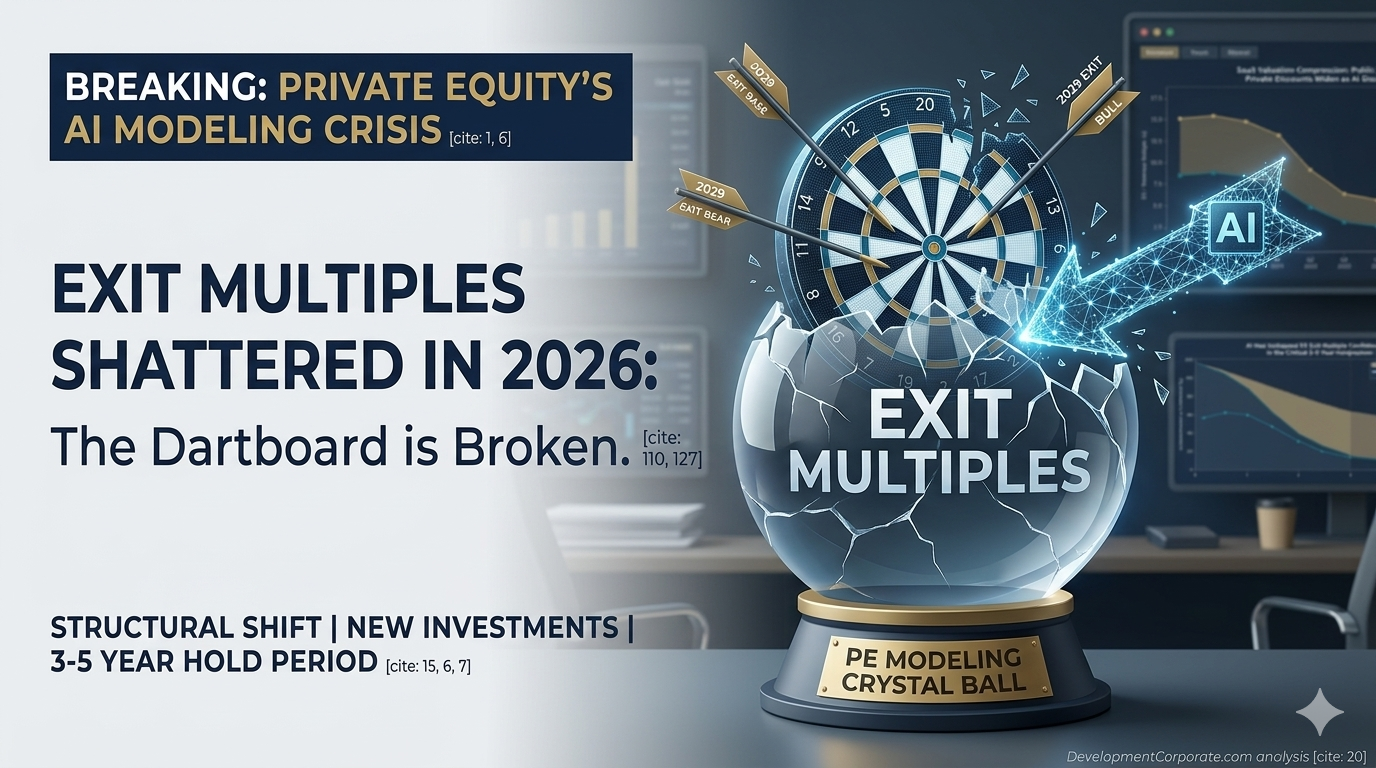
“Modeling exit multiples has always involved guesswork, but now it feels like throwing at a dartboard blindfolded.”
— Senior PE Veteran, Milken Global Conference 2026
That quote, reported by Axios, captures something important. This is not a temporary confidence gap that quarterly markdowns and debt renegotiations will fix. It is a structural collapse in deal underwriting certainty — and it has direct consequences for SaaS M&A dealflow, exit timing, and diligence frameworks.
The Modeling Crisis Is Structural, Not Cyclical
Most commentary on PE’s AI problem focuses on portfolio exposure: funds that loaded up on enterprise software now face EV/Revenue multiples at five-year lows. Public SaaS companies, which had briefly touched median multiples above 15x in early 2021, had compressed to below 5x by early 2026. Private company valuations, which trade at a structural discount to public peers, have compressed further still.
The public-to-private SaaS valuation gap has historically exceeded 50% — meaning a target that commands an 8x revenue multiple in the public market may realistically price at 4x or less in a private transaction. That compression, combined with AI-driven revenue uncertainty, creates a double squeeze on deal economics.
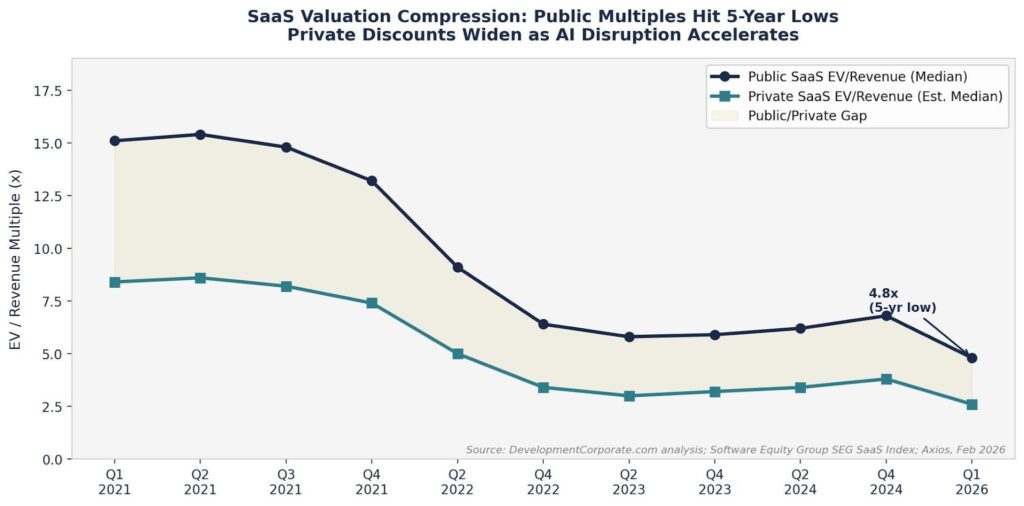
Figure 1: SaaS Valuation Compression, 2021–2026. Public multiples hit 5-year lows while private discounts widen. Source: DevelopmentCorporate.com analysis; Software Equity Group SEG SaaS Index.
But the portfolio write-down story is only half the picture. The more consequential — and less-discussed — problem is that AI has made forward-looking deal modeling structurally unreliable for new investments, regardless of sector.
Consider what a financial sponsor actually needs to underwrite a platform acquisition in 2026. They need a credible model for: revenue growth over a four-year hold, EBITDA margin expansion as the company scales, the exit multiple a buyer will pay in 2029 or 2030, and competitive dynamics in the target’s market. Every one of these inputs is now destabilized by AI.
- Revenue growth: AI is compressing pricing power across SaaS categories, creating churn risk in products that lack a differentiated AI roadmap
- EBITDA margins: AI-driven automation may expand or contract margins unpredictably depending on investment requirements and incumbent disruption
- Exit multiples: Buyers in 2029 will price AI-resilience as a primary criterion — but what that means in 2026 underwriting is impossible to model with precision
- Competitive dynamics: A company’s defensible moat can be eroded by a new AI-native entrant in twelve to eighteen months, not five years
Three and a Half Years: The Structural Mismatch
Here is the arithmetic that should alarm every deal team. A fund closing a new investment today will typically target an exit in 2029 or 2030 — a four-year horizon. As of May 2026, ChatGPT has existed for three and a half years. This means the entire generative AI era fits inside a single PE holding period.
No sector has had time to fully absorb the consequences of large language models, let alone the wave of agentic AI applications that began displacing workflows in 2025. Any model that assumes a stable competitive environment three years from now is not conservative — it is uninformed.
“Any financial sponsor who claims a high degree of confidence in the environment three-and-a-half years from now is either lying or self-deluded.”
— Axios, Milken Global Conference coverage, May 2026
This is not hyperbole. The Axios report noted that deal makers raised AI disruption concerns across sectors that are typically considered AI-resistant — not just software. Healthcare services, industrial distribution, financial services — all face modeling uncertainty driven by AI’s compounding pace of change.
The known unknowns, to use the classic framework, have multiplied. But more unsettling is the expansion of unknown unknowns: disruptions that cannot be anticipated from today’s vantage point but that will be obvious in retrospect when a fund reaches its exit window in 2029.
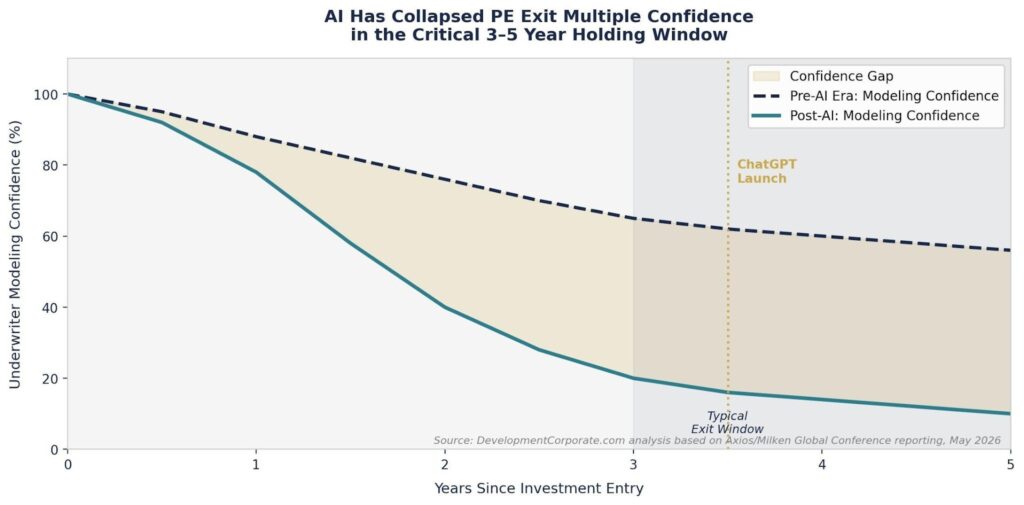
Figure 2: AI Has Collapsed Exit Multiple Confidence in the Critical Holding Window. The standard 3–5 year PE hold period now fully overlaps with generative AI’s unpredictable disruption timeline. Source: DevelopmentCorporate.com analysis.
The Defensive JV Play: What Anthropic and OpenAI Are Actually Telling You
The deal most widely covered alongside the Milken commentary is PE’s emerging partnerships with the AI labs themselves. Both Anthropic and OpenAI have now completed deals to form AI consulting arms, seeded by and initially targeting private equity portfolio companies.
The Anthropic joint venture is seeded with $1.5 billion, with Blackstone and Hellman & Friedman as lead investors alongside Goldman Sachs, General Atlantic, Leonard Green, Apollo, GIC, and Sequoia Capital. The OpenAI venture has drawn in Advent International, Bain Capital, Brookfield, and TPG.
Read these deals not as enthusiasm for AI but as acknowledgment of a structural problem. As Nicholas Lin, Anthropic’s head of product for financial services, told Axios: there is a large gap between what AI can currently do and the value enterprises are actually extracting from it. The JVs exist to close that deployment gap — not to validate vendor marketing claims about autonomous AI agents running entire business functions.
This aligns with what DevelopmentCorporate has tracked as the “autonomy gap” — the persistent distance between AI capability as benchmarked and AI capability as deployed at scale in regulated enterprise environments. PE-backed portfolio companies are among the worst-served by AI hype because they lack the internal technical resources to distinguish real ROI from demo performance.
The deeper signal: by partnering with the labs before exits, PE sponsors are trying to convert AI from a valuation headwind into a narrative asset. A portfolio company that can point to a structured AI deployment program — with measurable productivity gains — has a stronger CIM story than one that says “we are exploring AI opportunities.”
The AI Paradox: Heavy Spending, Zero Confidence
The data reveals a striking contradiction at the heart of PE’s AI moment. EY’s 2026 PE survey found that 38% of firms plan to direct more than half of their total budget to AI this year, while 42% are already allocating more than 25% of business unit budgets to AI initiatives.
Yet confidence in deal modeling has collapsed simultaneously. Firms are spending more on AI than at any prior point in history while simultaneously reporting the lowest conviction in forward-looking return assumptions of the past decade. This is not irrational — it is a rational response to a disruptive environment where standing still guarantees obsolescence. But it does mean that AI spend alone is not evidence of AI-readiness.
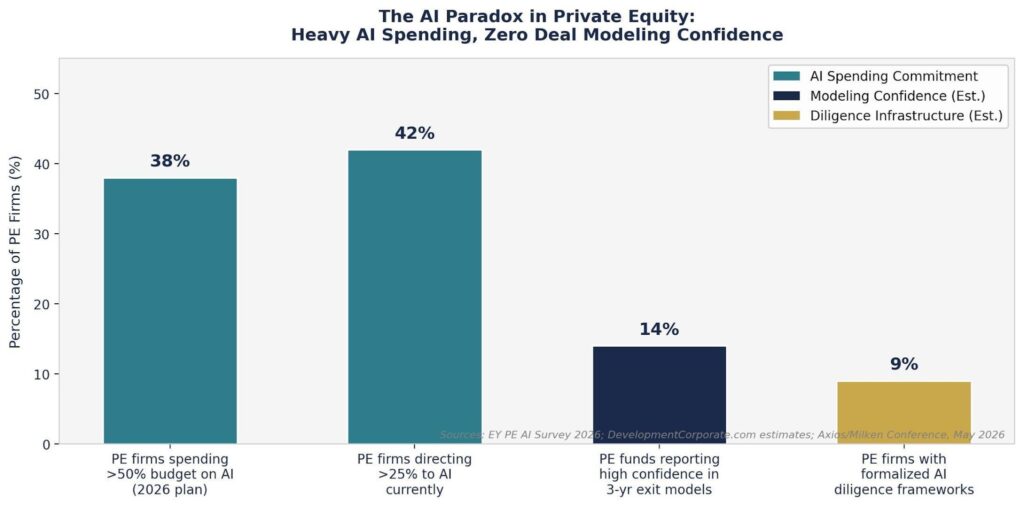
Figure 3: The AI Paradox in Private Equity. Heavy AI spending commitments coexist with near-zero confidence in forward exit modeling and minimal formalized AI diligence infrastructure. Source: EY PE AI Survey 2026; DevelopmentCorporate.com estimates.
Perhaps more alarming: most PE deal teams have no formal AI diligence framework. The standard M&A due diligence checklist — covering financials, legal, technology infrastructure, and commercial risks — does not include an AI resilience assessment as a standard module. This is a gap with direct valuation consequences.
A target company’s AI posture now encompasses several distinct risk dimensions that belong in every deal room: revenue durability as AI disrupts adjacent categories, product roadmap credibility against AI-native competitors, customer concentration risk from AI-enabled switching, and the cost structure impact of AI on the company’s own operations.
What This Means for SaaS Founders Preparing to Exit
The deterioration of PE modeling confidence creates both a risk and an opportunity for SaaS founders approaching a transaction in 2026. The risk: compressed multiples and heightened due diligence scrutiny around AI resilience. The opportunity: founders who build an AI-credibility narrative before entering a process can command premium positioning against peers who cannot articulate their AI strategy.
This is not about adding “AI-powered” to your marketing copy. It is about demonstrating to a financial sponsor that your revenue is defensible against AI substitution over a four-year hold. The Q3 2025 enterprise SaaS M&A analysis showed that best-in-class assets with differentiated positioning continued to attract premium attention even in a compressed market — but the bar for “differentiated” has risen sharply.
Three dimensions of AI-resilience are becoming standard expectations in buy-side diligence conversations. First, GEO (generative engine optimization) visibility — whether the target appears in AI-generated shortlists for enterprise software buyers. Second, product defensibility — whether the core technology creates switching costs that AI-native competitors cannot easily replicate. Third, internal AI adoption — whether the company is itself deploying AI to expand margins, which signals to sponsors that management understands the technology well enough to survive a hold period of uncertainty.
On the GEO dimension specifically: AI search visibility is an unpriced M&A due diligence gap. Standard deal rooms have no process to measure it, yet enterprise buyers now overwhelmingly begin vendor discovery through AI chatbots rather than Google. A target invisible to LLMs is losing top-of-funnel flow to named competitors — a CAC headwind that belongs in the deal model.
Stakeholder Implications
| WHAT THIS MEANS FOR YOUR STAKEHOLDER | |
| PE/VC INVESTORS | Your exit multiple assumptions are structurally unreliable for any deal closed before 2024. Retrofit AI resilience assessment into every existing portfolio company review. For new investments, build explicit AI disruption scenarios — bull, base, and bear — into your underwriting models. The JV deals with Anthropic and OpenAI are a hedge, not a solution: operational AI deployment at the portfolio company level is the actual value driver. |
| SAAS FOUNDERS | PE buyers entering your CIM in 2026 will scrutinize AI resilience harder than revenue growth. Build your AI narrative before the process — not during it. Quantify: your LLM citation footprint (GEO), any AI-enabled margin improvements, and your roadmap against AI-native competitors. If you cannot answer these questions credibly, assume a valuation haircut from every sponsor in your process. |
| ENTERPRISE CTOs / CPOs | If your company is PE-backed, the path to a clean exit is increasingly tied to demonstrable AI productivity gains. Your sponsor’s ability to model exit multiples depends partly on whether management can prove AI is compressing cost structure or expanding addressable market. Prioritize use cases with measurable ROI over moonshots. Proof of value in 2026 is a 2029 exit premium. |
A Six-Point AI Resilience Diligence Framework
Given the collapse in exit multiple confidence, deal teams need a structured way to assess AI risk in both new investments and portfolio company reviews. The following framework provides a starting foundation.
1. Revenue Durability Under AI Substitution
- Map the target’s core use cases against AI substitution risk on a 1–3 year horizon
- Assess customer concentration in categories where AI-native tools are already competing
- Stress-test NRR assumptions under a scenario where 15–25% of the addressable market shifts to AI-native alternatives
2. AI Visibility and Generative Engine Presence
- Conduct an LLM citation audit across ChatGPT, Perplexity, Gemini, and Claude
- Assess GEO posture using the five-tier citation scale from UNKNOWN to DOMINANT
- Flag any target with UNKNOWN or LOW citation scores as carrying unpriced customer acquisition cost risk
3. Product Moat Defensibility
- Identify proprietary data assets, network effects, or workflow integrations that create switching costs AI-native competitors cannot easily replicate
- Assess the depth of technical debt in core product infrastructure — AI-native rebuilds require clean architecture
- Evaluate the product roadmap against open-source and foundation model commoditization risk
4. Management AI Competency
- Interview the CTO and CPO on their specific AI deployment strategy, not their vision
- Require evidence of at least two AI initiatives with measurable productivity or cost outcomes
- Flag any leadership team that cannot articulate the difference between model fine-tuning and RAG (retrieval-augmented generation) — this signals a dangerous gap in technical judgment
5. Competitive Landscape AI Trajectory
- Map the competitive set for AI-native entrants that have launched in the past eighteen months
- Assess whether incumbents in the space are losing net new ARR to AI-native competition
- Build a scenario model for what happens to the target’s gross margin if an AI-native competitor achieves 30% of the market within the hold period
6. Exit Market AI Premium Assessment
- Model three exit multiple scenarios: AI headwind (target is disrupted, multiple contracts), AI neutral (status quo maintained), AI tailwind (target is an AI beneficiary, multiple expands)
- Weight scenarios probabilistically based on product category and management execution track record
- Do not anchor exit assumptions to the 2021 multiple environment under any circumstances
The Dartboard Is Not Going Away
The Milken commentary from senior PE deal makers is not a temporary expression of uncertainty. It is an acknowledgment that a fundamental input to deal underwriting — the exit multiple — has become structurally unreliable for a period that is likely to extend through at least the mid-2020s.
Private equity has navigated uncertainty before. The 2008 financial crisis, the 2020 pandemic, the 2022 rate shock — each disrupted the modeling environment temporarily. What makes AI different is the self-reinforcing compounding nature of the disruption: each new capability release expands the range of possible outcomes in both directions, simultaneously raising the ceiling for AI-enabled businesses and lowering the floor for AI-disrupted ones.
The funds that adapt fastest will not be those that spend the most on AI consulting — though the Anthropic and OpenAI JV deals will generate impressive PR. They will be the funds that build AI resilience assessment into the front end of their diligence process, before valuation discussions begin. And they will be the funds whose portfolio companies enter exit processes with a credible, quantified AI narrative rather than a slide deck of aspirations.
“The exit multiple uncertainty is not the problem. It is a symptom. The problem is that most deal teams do not yet have a framework for measuring what they cannot see.”
For SaaS founders, the window to build that narrative is narrow. A company that enters a 2027 process having systematically invested in AI resilience — measurable GEO visibility, documented AI productivity gains, a credible roadmap against AI-native competition — will command meaningfully better terms than one that arrives reactive to the conversation.
Is AI Uncertainty Affecting Your Deal Valuation?
DevelopmentCorporate provides M&A advisory services for enterprise SaaS companies navigating AI disruption. We help founders build AI-resilient exit narratives and help buyers build AI diligence frameworks that price what standard due diligence misses.