The Software LBO Freeze: What the GXS Era Teaches Enterprise CEOs
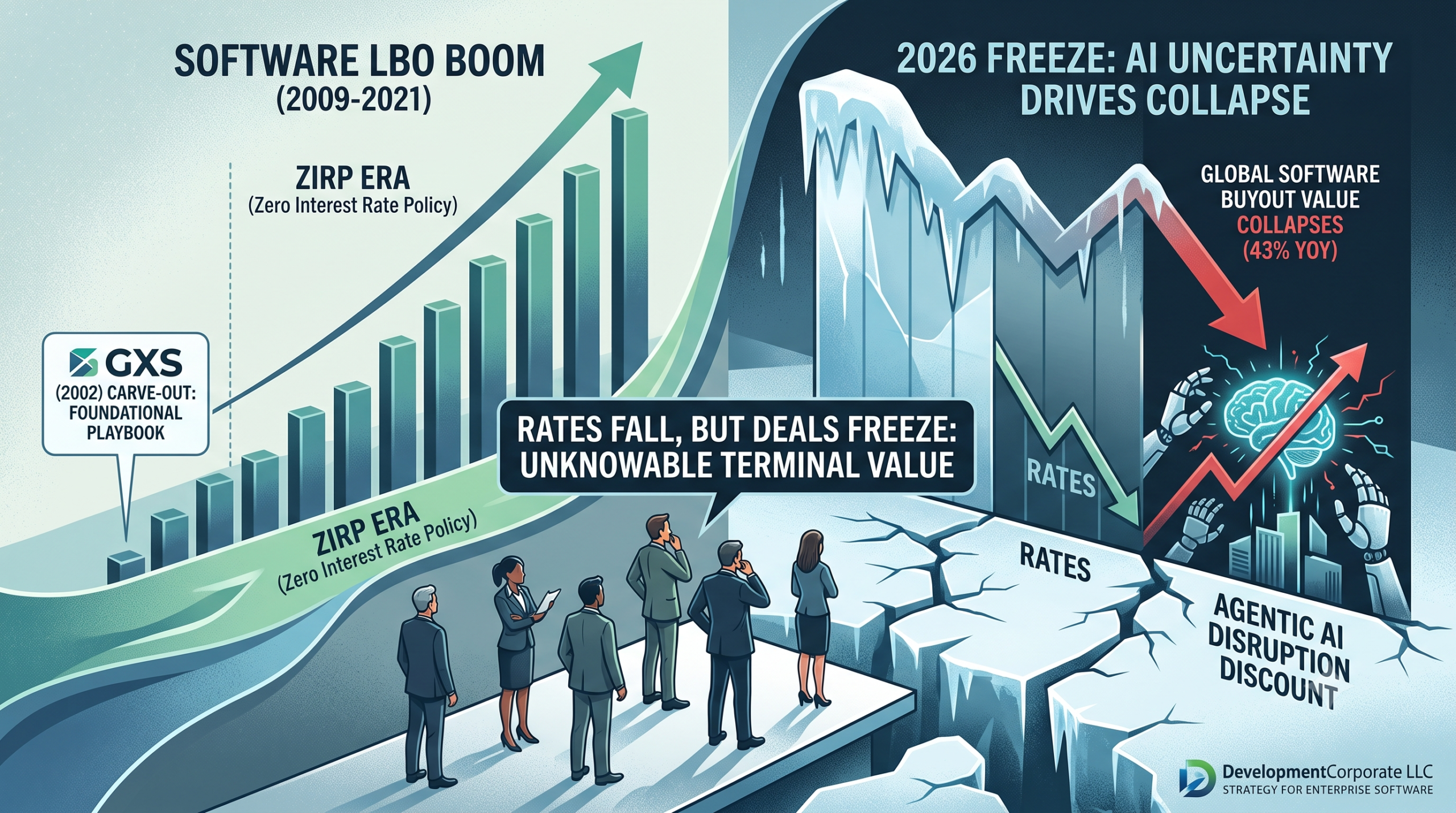
The software LBO — the deal structure that turned enterprise software into private equity’s favorite asset class — just hit a wall. The Financial Times, citing PitchBook data, reports that global software buyout value collapsed to roughly $50 billion in the first five months of 2026, down from $88 billion over the same period in 2025. That is the weakest start to a year since the pandemic — and it comes twelve months after 2025 set an eleven-year high of $290 billion in software buyouts.
Falling deal volume is normally a rate story. Not this time. Rates have been drifting down since 2025. The buyers froze anyway, because the one thing an LBO model cannot tolerate is an unknowable terminal value — and AI has made the terminal value of an average software company unknowable. As Arma Partners’ Paul-Noël Guély told the FT, an investor who cannot estimate what a business is worth after AI adoption cannot get a deal past an investment committee.
If you run an early-stage enterprise software company, this freeze is not a spectator sport. Private equity has been the hidden floor under the entire SaaS exit market for two decades. To understand what happens when that floor moves, it helps to go back to the moment it was poured: 2002, when Francisco Partners carved GXS out of General Electric and invented the modern software LBO playbook in the wreckage of the last great tech crash.
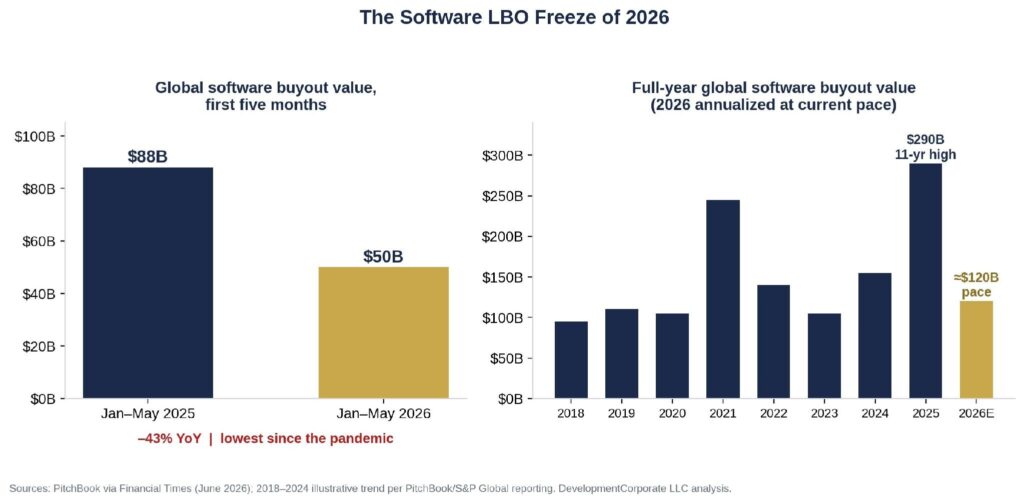
Figure 1: Software buyout value fell 43% year over year in early 2026 — the weakest pace since 2018. Sources: PitchBook via FT; DevelopmentCorporate LLC.
2002: The First Cheap-Money Era and the Birth of the Software LBO
In June 2002, the enterprise software industry was radioactive. The Nasdaq had lost nearly 80% of its value. Sarbanes-Oxley was weeks from passage. Nobody wanted to touch technology assets — which is exactly when Francisco Partners, then a three-year-old firm billing itself as the world’s largest technology-focused buyout fund, agreed to buy GE Global eXchange Services from General Electric in a transaction valuing the business at roughly $800 million.
GXS was not glamorous. It was a B2B e-commerce and EDI network — more than 100,000 trading partners, over a billion transactions a year moving roughly $1 trillion in goods and services, and a customer list covering more than 60% of the Fortune 500. GE even kept a 10% stake and provided $235 million of subordinated notes through GE Capital to get the deal done. Translation: the debt markets were so shut that the seller had to finance its own exit.
The thesis was simple and, at the time, contrarian: mission-critical infrastructure revenue does not churn just because the stock market panicked. Buy it with leverage while everyone else is afraid, run it for cash, consolidate the category, and wait. Twelve years and six add-on acquisitions later — including IBM’s EDI business — OpenText bought GXS for $1.165 billion in January 2014. The Fed had made the trade possible: the funds rate fell from 6.5% in 2000 to 1% by 2003, and cheap post-dotcom money turned distressed enterprise software into the best leveraged asset in the market.
Every software LBO since — SunGard in 2005, the entire Vista and Thoma Bravo model, the 1,900-plus PE software acquisitions completed between 2015 and 2025 — descends from that playbook: sticky revenue, contractual switching costs, leverage, and time.
ZIRP Turned the Playbook Into an Industry
What the post-dotcom era started, the zero-interest-rate-policy era industrialized. From 2009 through 2021, with the Fed funds rate pinned near zero for most of thirteen years, the software LBO stopped being a contrarian trade and became an asset class. Recurring revenue was treated as bond-like. Lenders stopped underwriting profits and started underwriting ARR itself — a practice so normalized that loans were routinely priced against revenue at companies with no earnings at all.
That era is over, and the credit markets called it before the equity markets did. As we documented in SaaS Private Credit Lenders Are Done With ARR, every one of the eight software loans Lincoln International placed in early 2026 was underwritten on EBITDA — not one on ARR. JPMorgan’s preemptive markdown of its software loan book in March 2026 was the institutional confirmation: the bank repriced software collateral on valuation logic alone, before any wave of defaults. Credit repricing has led equity M&A repricing by 6 to 18 months in every cycle we track — which is precisely the sequence the FT’s buyout data now shows playing out.
2026 Rhymes With 2002 — But the Melody Is Different
The similarities between the two moments are real, and worth listing, because they explain why the freeze is unlikely to be permanent:
- A valuation reset nobody trusts. In 2002 it was dotcom wreckage; in 2026, software valuations fell roughly 8% in Q1 alone while every other sector was flat, per Bain’s analysis of Dealogic data. Public SaaS bellwethers are down 25–30% from their peaks.
- A buyer’s market with no buyers. Fear, not fundamentals, sets the clearing price. In 2002 GE had to lend Francisco Partners the money. In 2026, platform buyouts have fallen to 41% of software PE deal value — the lowest share in at least a decade — while add-ons and growth equity fill the gap.
- Record dry powder waiting on conviction. Thoma Bravo alone raised $34.4 billion across three funds. The capital did not disappear; it is waiting for an underwriting model it can defend.
Now the difference — and this is the part that should reorganize your planning. The 2002 freeze was a price problem: buyers and lenders disagreed about value in a familiar business model. It thawed the moment cheap money returned. The 2026 freeze is a model problem: buyers cannot agree on whether the seat-based software business model itself survives agentic AI. Rates are already falling, and deals froze anyway. Cheap money cannot fix an underwriting question; only evidence can.
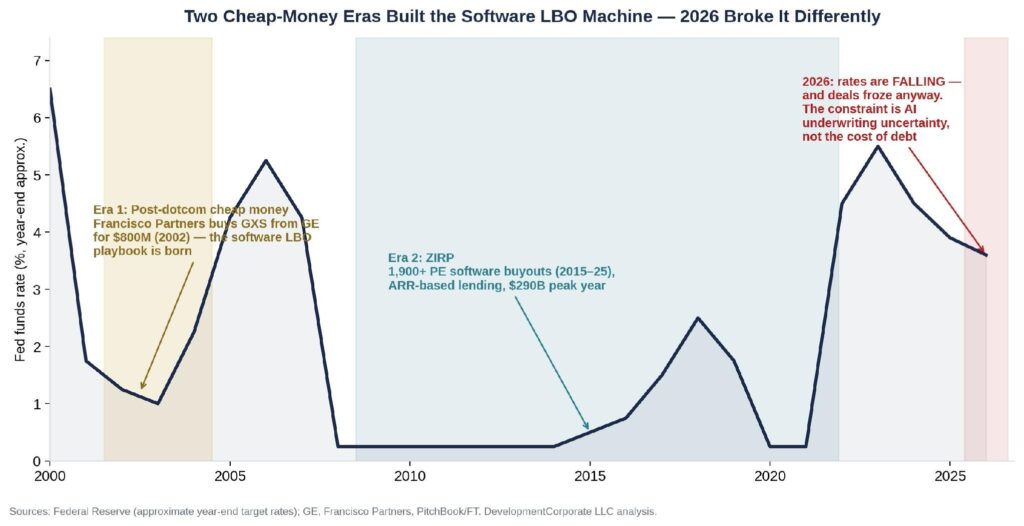
Figure 2: The GXS deal (2002) and the ZIRP explosion were both rate stories. The 2026 software LBO freeze happened while rates were falling — the constraint is AI underwriting uncertainty. Sources: Federal Reserve; GE; PitchBook/FT; DevelopmentCorporate LLC.
The Gap Thesis: The Freeze Measures Uncertainty, Not Obsolescence
Here is the contrarian read. The consensus interprets the FT’s numbers as evidence that private equity believes software is dying. The data says something narrower and more useful: PE believes software is un-underwritable at current information levels. Those are very different claims — and the gap between them is where the opportunity sits.
Deals that can be underwritten are still clearing. Thoma Bravo signed a $12 billion deal for Dayforce and a $2 billion take-private of Verint in the same market that produced the freeze. Blackstone’s CFO told analysts that well-entrenched businesses with attractive moats may be net beneficiaries of AI. And as we argued in The SaaS-Pocalypse Is a Buying Signal, credit markets are applying a generic disruption discount that has not been calibrated against actual agentic deployment timelines — which PitchBook itself places at late 2027 for widespread enterprise viability.
Even the scariest headline number cuts both ways. Gartner’s warning that $234 billion of application spend is exposed to agentic disruption by 2030 describes, on Gartner’s own language, a repricing toward consumption and outcome models — not spend that vanishes. Markets that reprice must be underwritten asset by asset. That is exactly the discipline the 2002 vintage rewarded: Francisco Partners did not buy ‘tech.’ It bought one specific network whose transaction volume was independent of the Nasdaq. The 2026-27 vintage will reward the same specificity — and history suggests the deals struck during maximum fear become the best-returning ones.
What Early-Stage Enterprise Software CEOs Should Do Now
If PE was your implicit exit plan — and for most enterprise software companies it was, whether stated or not — the underwriting bar just moved. Five moves matter:
1. Build an EBITDA story, not just an ARR story
Your eventual buyer’s lender no longer accepts ARR as collateral. A company that reaches $10–20 million ARR with credible unit economics and a visible path to real earnings is financeable in the new regime; a growth-at-all-costs comparable is not. The 2026 benchmark data puts the markers at ARR-per-employee above $175K and R&D-to-revenue below 30%.
2. Score your moat before a buyer scores it for you
The bifurcation between AI-defensible and AI-exposed assets has hardened from a valuation preference into a financeability line. Run your business through a Seven Powers-style analysis — proprietary data, embedded workflows, switching costs — using a framework like our SaaS Moat Scorecard. If your value can be replicated by a foundation-model upgrade, no multiple survives diligence.
3. Defend gross revenue retention like a covenant
Median GRR fell from 88% to 84% last year — the largest single-year decline on record — and buyers now treat retention decay as the leading indicator of AI displacement. Every logo save is a valuation defense.
4. Get ahead of the pricing-model transition
Hybrid and usage-based pricing carries a structural 13-point NRR advantage that compounds annually. If agentic arbitrage breaks the link between seats and value, migrate your pricing before your renewal base forces the issue.
5. Manufacture underwriting evidence
The freeze ends company by company, as individual assets produce evidence that survives an investment committee. Multi-year win/loss programs, cohort-level retention data, and documented AI-era displacement tests are that evidence. The macro machinery behind this shift — why credit moves first and equity follows — is laid out in our analysis of the AI capex credit cycle.
| For PE/VC InvestorsThe 2002 analogue argues for underwriting courage, not abstinence. Platform LBO share at a decade low means clearing prices for durable-moat assets are set by fear. The edge is a diligence stack that can distinguish repricing exposure from displacement exposure — agentic-arbitrage sensitivity by revenue line, GRR decay analysis, and EBITDA normalization. The 2026–27 vintage will look like the 2002–04 vintage did by 2014. |
| For SaaS Founders Approaching ExitAssume your buyer’s lender underwrites EBITDA, not ARR, and that your data room must answer the AI question before it is asked. If you cannot document moat durability and retention stability today, the rational move is to spend 12–18 months manufacturing that evidence rather than accepting a generic disruption discount in this window. |
| For Enterprise CTOs and CPOsYour vendors’ ownership structure is your roadmap risk. PE-owned platforms facing EBITDA-based refinancing will cut R&D before they cut margin. Diligence vendor capital structures the way investors do: maturity walls, sponsor behavior, and whether the AI roadmap is funded or aspirational. |
Conclusion: The Best Software LBO Vintages Are Born in Fear
The software LBO is not dead. It is being re-founded — the same way it was founded — in a moment when consensus says enterprise software is untouchable. In 2002, the freeze broke when cheap money met a contrarian thesis about mission-critical revenue. In 2026, it will break when underwriting evidence meets record dry powder. The CEOs who spend this freeze building EBITDA credibility, defensible moats, and documented retention will sell into that thaw at premiums. The ones who wait for the old ARR machine to restart will discover it was dismantled while they waited.
DevelopmentCorporate LLC advises enterprise SaaS founders, boards, and investors on M&A strategy, valuation, and AI-era due diligence — with $175M+ in completed acquisitions. If you are planning an exit or an acquisition into this repricing, contact us at developmentcorporate.com.